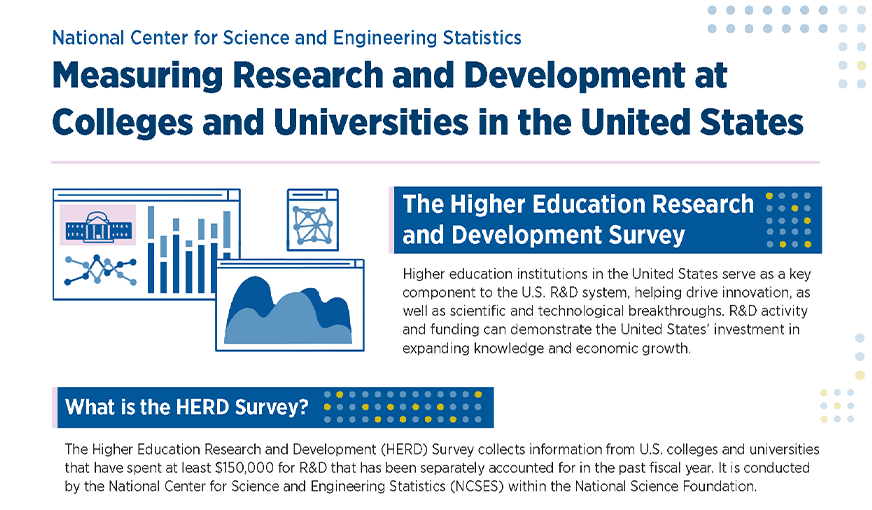
Purpose. The Higher Education Research and Development (HERD) Survey is the primary source of information on separately accounted-for R&D expenditures within higher education institutions in the United States and outlying areas.
Data collection authority. The information is solicited under the authority of the National Science Foundation Act of 1950, as amended, and the America COMPETES Reauthorization Act of 2010. The Office of Management and Budget control number is 3145-0100, with an expiration date of 31 July 2025. NCSES has reviewed this product for unauthorized disclosure of confidential information and approved its release (NCSES-DRN25-060).
Survey contractor. ICF.
Survey sponsor. The HERD Survey is sponsored by the National Center for Science and Engineering Statistics (NCSES) within the U.S. National Science Foundation.
Target population. Public and private nonprofit postsecondary institutions in the United States, Guam, Puerto Rico, and the U.S. Virgin Islands that granted a bachelor’s degree or higher in any field; expended at least $150,000 in separately accounted-for R&D in FY 2024; and were geographically separate campuses headed by a president, chancellor, or equivalent. A list of all accredited, degree-granting institutions in the United States (the Higher Education Directory) was obtained from Higher Education Publications (HEP). More information about HEP and its sources can be found at https://hepinc.com/about/.
The survey population was reviewed before data collection began to ensure that each institutional classification was accurate. Characteristics of the schools were reviewed before and during the survey to determine whether changes had occurred (e.g., name; highest degree granted; school openings, closings, or mergers). Table A-1 shows all institution name changes or mergers between the FY 2023 and FY 2024 surveys.
After data collection closed, institutions were reviewed to verify that only those reporting at least $150,000 in separately accounted-for R&D were included in reporting for the target population.
Sampling frame. The frame for the FY 2024 HERD Survey included (1) all institutions considered in scope for the FY 2023 survey, (2) institutions that granted a bachelor’s degree or higher and reported an amount greater than $0 for research on the Integrated Postsecondary Education Data System (IPEDS) 2022 Finance Survey, (3) all U.S. service institutions that granted a bachelor’s degree or higher and were not already part of the HERD Survey population, and (4) institutions that granted doctoral degrees but did not report to IPEDS and were not already part of the HERD Survey population. The information in the Higher Education Directory was used to locate institutions meeting the conditions listed in 3 and 4. When FY 2023 R&D expenditures for the institutions were not known or confirmation was needed to ensure the reported IPEDS R&D total met HERD guidance, institutions in the frame were sent a brief questionnaire asking whether the institution had R&D expenditures during FY 2023 and FY 2024 and whether those expenditures were less than $150,000, were $150,000 to $999,999, or were $1 million or more.
The population review screener was sent to 133 institutions. A total of 31 institutions were added to the survey population during the population review. Two other institutions were added when representatives of university systems contacted data collection staff about a campus that newly qualified for the survey. During data collection, 19 institutions were removed from the population after they indicated that their R&D expenditures were less than $150,000 for FY 2024, or that they did not qualify for the survey for another reason. Of the 925 institutions surveyed, 18 completed the survey but reported total R&D expenditures of less than $150,000. These institutions were excluded from the population, and their data are not included in the FY 2024 survey totals. The total and federally funded R&D expenditures for these 18 institutions are listed in table A-2. After accounting for these additions and subtractions, the number of academic institutions in the final population increased from 911 in FY 2023 to 925 in FY 2024 (table A-3).
Sample design. The FY 1997 survey was the last one conducted as a sample survey. Since FY 1998, the survey has been a census of all known eligible universities and colleges.
Data collection. The FY 2024 questionnaires were sent by e-mail in November 2024. Respondents could choose to download the questionnaire and submit it via e-mail to the HERD support desk or use a Web-based data collection system. Every effort was made to maintain close contact with respondents to preserve both the consistency and continuity of the resulting data. Survey data reports for each institution were available in two formats on the survey website throughout the data collection to help respondents identify their data trends and anomalies. The first format showed comparisons between the current and 2 prior years of data and noted any substantive disparities and narratives provided by respondents to explain those disparities. The second format was a data file including all data reported in the previous 5 years. Questionnaires were carefully examined for completeness upon receipt. Respondents were sent personalized e-mail messages asking them to provide any necessary revisions before the final processing and tabulation of data. These e-mail messages included a link to the HERD Survey Web-based data collection system, allowing respondents to view and correct their data online.
Respondents were asked to explain significant differences between current year reporting and established patterns of reporting verified for prior years. They were encouraged to correct prior year data, if necessary. When respondents updated or amended figures from past years, NCSES made corresponding changes to trend data included in the products released from the FY 2024 survey. For accurate historical data, use only the most recently released data.
Mode. Respondents could choose to submit a questionnaire downloaded from the Web or use the Web-based questionnaire. Almost all institutions submitted data using the Web-based questionnaire; 8 institutions e-mailed their data as an attachment to the survey contractor.
Response rates. By the survey’s closing date in July 2025, forms had been received from 881 universities and colleges out of a population of 925—a response rate of 95.2%. Responses were received from 97.0% of all doctorate-granting institutions. The R&D expenditures reported by these doctoral institutions constituted 99.1% of the estimated national R&D expenditures for FY 2024. Table A-4 displays a detailed breakdown of response rates by survey form and highest degree granted, and table A-5 displays a breakdown of response rates for each survey question.
Data editing. The HERD Survey was subject to very little editing. Respondents were contacted and asked to resolve possible self-reporting issues themselves. Questionnaires were carefully examined by survey staff upon receipt. Reviews focused on unexplained missing data, expenditures that were outliers compared to those of peer institutions, and explanations provided for changes in reporting patterns. If additional explanations or data revisions were needed, respondents were sent personalized e-mail messages asking them to provide any necessary revisions before the final processing and tabulation of data.
Imputation. Missing values were imputed based on the previous year’s data and the reported data of peer institutions in the current cycle. For the 40 institutions that had not responded by the closing date of the survey and had been included in the FY 2023 HERD Survey population, R&D expenditures were imputed by applying inflator and deflator factors to the prior year’s key totals. The key totals for FY 2024 included total R&D expenditures, federal R&D expenditures, expenditures received as a subrecipient from higher education sources, expenditures received as a subrecipient from non-higher education sources, expenditures passed through to higher education entities, and expenditures passed through to non-higher education entities. Imputation factors were ratios derived from the 2-year trend data of responding institutions with similar characteristics, including highest degree granted, type of institutional control (public or private), and level of total R&D expenditures. Other values that were not identified as key totals were imputed by applying ratios derived from the institution’s previous year data.
For four institutions that were new to the survey population, no previous year data were available. For this institution, total R&D expenditures were estimated based on the institution’s responses to the population review screener. Other values were then imputed as a proportion of total R&D expenditures based on the data of institutions with similar characteristics. Data for partial nonresponse were imputed using similar techniques.
Table A-6 through table A-20 present imputed amounts for each applicable survey variable. The dollar amount imputed is displayed, along with the percentage it represents of the national estimate for universities and colleges for a variable. The imputed total R&D was $460.1 million, or 0.4%, of the $117.7 billion in total R&D expenditures (table A-6).
Several surveyed institutions have responded intermittently in past years. For years in which no response was received, data have been imputed as previously described. Although the imputation algorithm accurately reflects national trends, it cannot account for specific trends at individual institutions. For this reason, a re-imputation of institutional data for prior years is also performed. For each institution, previously imputed values from the HERD Survey (FYs 2010–23) were recomputed to ensure that the imputed data are consistent with reporting patterns from the FY 2024 survey. These procedures result in much more consistent reporting trends for individual institutions but have little effect on aggregate figures reflecting national totals. In the data tables, the letter “i” is used to identify imputed data.
R&D expenditures from unspecified federal agencies (Question 10) and capitalization thresholds for software and equipment (Question 13) were not imputed. Response summaries for these questions can be found in table A-21 and table A-22.
Weighting. Survey data were not weighted.
Variance estimation. No variance estimation techniques were used.
Sampling error. Because the FY 2024 survey was distributed to all institutions in the universe, there was no sampling error.
Coverage error. Coverage error of large research institutions is minimal because of comprehensive lists. These institutions are easily identified using the NCSES Survey of Federal Science and Engineering Support to Universities, Colleges, and Nonprofit Institutions. However, institutions with smaller amounts of R&D expenditures have been more difficult to identify because they often do not receive federal funding for science and engineering (S&E) R&D.
Nonresponse error. Forty-four universities and colleges did not respond in FY 2024, out of a total of 925 eligible institutions, for a nonresponse rate of 4.8%. Table A-4 displays a detailed breakdown of response rates by survey population and highest degree granted.
Nonresponse rates were less than 5.0% for all but three questions. Question 6, R&D expenditures by type of R&D (basic research, applied research, and experimental development); Question 15, R&D personnel headcount; and Question 16, R&D full-time equivalents (FTEs) had nonresponse rates of 6.5%, 10.2%, and 22.9%, respectively. Table A-5 displays a breakdown of response rates for each question in each of the two surveys. See section “Imputation” for mitigation of item nonresponses. Table A-6 through table A-20 present imputed amounts for each applicable survey variable.
Measurement error. The most likely source of measurement error is institutional records containing categories different from those on the survey. For example, institutions were asked to report all R&D expenditures by field. The NCSES-designed fields do not always translate to an institution’s departmental structure, and adjustments must be made by the institution to complete the survey. Fields were revised for the FY 2016 survey to better reflect the R&D currently being conducted at universities and colleges and make HERD Survey fields more consistent with those used by other NCSES surveys as well as with the National Center for Education Statistics Classification of Instructional Programs (CIP) codes. Details of this change are included in the methodology report and technical notes for the FY 2016 survey. Minor revisions were also made in FY 2020.
Another source of error is the survey’s category of institutionally funded research. The survey requests that institutions report discretionary internal funds used for research. NCSES discovered through debriefings conducted at the conclusion of the FY 2010 survey that there were varying definitions of what should be included on the HERD Survey as institutionally funded research. Some institutions included all expenditures from separate accounts designated for research; others included only internal R&D projects that are competitively awarded and have detailed budgets. A workshop was held in summer 2012 to discuss these differences in definitional interpretation. Based on the findings from the workshop, the FY 2012 survey was modified to clarify that all expenditures designated for research can be included in this category. This includes expenditures for organized research and expenditures of other funds designated for research but not categorized as organized research. A checklist question (Question 1.1) was also added to encourage the inclusion of all eligible expenditures and to determine the full extent of the variations in reporting across institutions. This question has been on the survey since FY 2012. An analysis of Question 1.1 responses from FY 2024 indicated that some institutions still could not report institutionally funded research that was not organized research (6.2% could not report startup packages, bridge funding, or seed funding and 7.0% were unable to identify other departmental funds designated for research). Therefore, survey totals are missing expenditures for R&D that come from multipurpose accounts, and as such, they represent an undercount of the total amount of internal discretionary funding that institutions make available to conduct R&D.
The reporting of unrecovered indirect costs is another known source of error. The survey requests that the total amount of indirect costs associated with a research grant or contract be calculated and reported, including costs that were not reimbursed by the external funding source. The unrecovered indirect cost is calculated by multiplying the institution’s negotiated indirect cost rate by the corresponding base and then subtracting the actual indirect cost recovery, preferably on a project-by-project basis. In FY 2024, 5.2% of respondents reported unrecovered indirect costs as unavailable. Respondents who were unable to provide values were asked to provide information on their nonresponse. Based on the collected information, survey guidance is revised to encourage response.
The reporting of expenditures from projects that are not R&D is another possible source of error. The R&D in the HERD Survey excludes public service grants, outreach programs, curriculum development, or training grants that do not support work on research projects. As part of a federal government effort to reduce administrative burdens associated with research grants and contracts, agencies began adopting Research Terms and Conditions (RTC) to be consistent with Uniform Administrative Requirements, Cost Principles, and Audit Requirements for Federal Awards issued by the U.S. Office of Management and Budget (OMB) in the Federal Register [80 FR 61849, October 14, 2015]. In these RTCs, agencies employed a broader definition of research, resulting in many institutions reporting projects as research that do not match HERD Survey definitions. Additionally, in recent years R&D expenditure data has been used more frequently in university and college benchmarking, which may encourage institutions to employ broader definitions of research than those provided on the survey.
It should also be noted that because institutions were asked to include funds passed through to higher education institutions as well as subrecipient funding from higher education institutions, there is double counting included in national and group totals. For example, Institution A’s survey included the $2 million passed through to Institution B, and Institution B’s survey also included the $2 million in subrecipient funding that it received from Institution A. Overall, institutions reported $6.0 billion in expenditures from subrecipient funding received from other universities in FY 2024 and $5.8 billion in funds passed through to higher education subrecipients in FY 2024. Adjustments are made accordingly to R&D totals presented in the NCSES National Patterns of R&D Resources.
Annual data are available for FYs 1972–2024. When the review for consistency between each year’s data and submissions in prior years reveals discrepancies, it is sometimes necessary to modify prior years’ unreported data. This is especially likely to affect trends for certain institutions that fail to report every year because current year data are used to impute prior year data. For accurate historical data, use only the most recently released data tables. Individuals wishing to analyze trends other than those in the most recent data tables are encouraged to contact NCSES for more information about comparability of data over time.
Changes in survey coverage and population. Before FY 2010, the population included only institutions with R&D expenditures and degree programs in S&E fields. Institutions that performed R&D in only non-S&E fields were excluded from the population. Although not a change in the coverage or population, each campus headed by a campus-level president, chancellor, or equivalent began completing a separate survey in 2010 rather than combining its response with the responses of other campuses in the university system. As a result, the overall number of academic institutions in the population increased from 711 in FY 2009 to 742 in FY 2010.
To compare HERD Survey data across university systems by aggregating member campuses, table 5 shows all institutions in the FY 2024 population by state, institutional control, and system.
Universities and colleges can merge or separate, possibly resulting in large changes in data from previous years.
- For FY 2015, the Indiana University School of Medicine (IUSM) reporting line was changed from the Chancellor of the Indiana University-Purdue University, Indianapolis (IUPUI) campus to the President of Indiana University. As such, the research expenditures for IUSM are now included in the Indiana University–Bloomington figures, resulting in an increase in total R&D expenditures of approximately $280 million for this campus. IUPUI total R&D expenditures decreased from $324 million in FY 2014 to $56 million in FY 2015.
- In September 2015, Yeshiva University relinquished control of Albert Einstein College of Medicine to Montefiore Health System. As a result, FY 2016 data for Yeshiva University included only 2 months (July–August 2015) of R&D expenditures from the college of medicine. Albert Einstein College of Medicine reported separately for its entire FY 2016 (January–December 2016). Because of this change, FY 2016 research expenditures for Yeshiva University decreased by $260 million. For FY 2017, Yeshiva University included no expenditures from the college of medicine, and total research expenditures decreased by $43 million.
- In 2016, the Maryland General Assembly approved legislation to create a strategic partnership between University of Maryland (UMD) College Park and UMD Baltimore. The two schools began reporting as one unit, University of Maryland, in FY 2019. In FY 2018, UMD Baltimore reported over $475 million in total R&D expenditures, and UMD College Park reported over $540 million in total R&D expenditures. In FY 2019, the new combined institution reported $1,096 million in total R&D expenditures.
- In 2019, University of Tennessee reorganized University of Tennessee, Knoxville, Institute of Agriculture, and University of Tennessee, Knoxville. The two schools began reporting as one unit, University of Tennessee, Knoxville, in FY 2020. In FY 2019, University of Tennessee, Institute of Agriculture reported over $71 million in total R&D expenditures, and University of Tennessee, Knoxville reported over $240 million in total R&D expenditures. In FY 2020, the new combined institution reported $320 million in total R&D expenditures.
- In 2021, the University of South Florida consolidated its three separate institutions, University of South Florida, Tampa; University of South Florida, St. Petersburg; and University of South Florida, Sarasota-Manatee, into one, singularly accredited university. The three schools began reporting as one unit, University of South Florida, in FY 2021. In FY 2020, University of South Florida, Tampa reported over $333 million in total R&D expenditures; University of South Florida, St. Petersburg reported over $18 million in total R&D expenditures; and University of South Florida, Sarasota-Manatee reported over $2 million in total R&D expenditures. In FY 2021, the new combined institution reported over $405 million in total R&D expenditures.
- In FY 2021, the University of Colorado Denver and Anschutz Medical Campus began reporting to the survey separately. Prior to FY 2021, the two campuses reported as one unit. In FY 2020, the combined unit reported over $554 million in total R&D expenditures. In FY 2021, University of Colorado Anschutz Medical Campus reported over $562 million in total R&D expenditures, and University of Colorado Denver reported over $18 million in total R&D expenditures.
- In FY 2023, the University of Nebraska Lincoln, Medical Center, and central administration began reporting as one unit, University of Nebraska, Lincoln and Medical Center. In FY 2022, the University of Nebraska, Lincoln reported over $340 million in total R&D expenditures, University of Nebraska, Medical Center reported over $205 million in total R&D expenditures, and the University of Nebraska central administration reported over $25 million in total R&D expenditures. In FY 2023, the new combined institution reported over $617 million in total R&D expenditures.
- In FY 2024, the University of Oklahoma, Tulsa and the University of Oklahoma, Norman and Health Science Center began reporting as one unit, the University of Oklahoma. In FY 2023, the University of Oklahoma, Tulsa reported over $5.8 million in total R&D expenditures, and the University of Oklahoma, Norman and Health Science Center reported over $436 million in total R&D expenditures. In FY 2024, the new combined institution reported over $474 million in total R&D expenditures.
Changes in questionnaire. Tables include data from the Academic R&D Expenditures Survey (FYs 1972–2009) and the HERD Survey (FYs 2010–20). Analysts should be cautious when examining trend data. Although many variables are similar across the two surveys because of clarification of which funds are to be included in the definition of R&D and the inclusion of non-S&E expenditures, exact comparisons may be misleading. In prior years, the Academic R&D Expenditures Survey collected expenditures for S&E and non-S&E fields separately. Institutions were not always able to provide non-S&E expenditures, and those data were not imputed previously. Also, revisions to the instructions on what types of activities are included as R&D in 2010 may have influenced reported values to varying degrees, depending on the number of clinical trials and training grants at an institution. Specific changes are described below:
- For the FY 2012 data collection, NCSES modified the survey instructions to clarify what types of institutionally funded activities should be included in reported data. The instructions explained that all expenditures for R&D from an institution’s current operating funds that are separately accounted-for should be reported. This includes expenditures separately budgeted for organized research and expenditures of other funds designated for research but not categorized as organized research. The instructions also specified that funds from an institution’s 501(c)3 foundation should be reported under institutionally financed research.
- For the FY 2013 collection, the instructions were revised to clarify that funds from foreign and U.S. universities and colleges should be reported under All other sources (Question 1, row f). The instructions also specified that gifts designated by donors for research should be included in Question 1, row f.
- Several changes were made to the FY 2016 questionnaire:
- Question 16 on the FY 2015 questionnaire, regarding the number of postdocs paid from R&D expenditures, was removed from the survey. Question 2, regarding foreign funding of R&D, was expanded to identify sources of foreign funding. The question now collects R&D expenditures funded by foreign governments, businesses, nonprofit organizations, and higher education (see foreign sources in the “Definitions” section for additional information).
- Questions 9, 11, and 14 include revisions to the fields of R&D that better reflect the R&D currently being conducted at universities and colleges. The revisions make the HERD Survey fields more consistent with those used by other NCSES surveys as well as with the CIP codes.
- For the FY 2017 collection, the instructions were revised to clarify that funding from federally funded R&D centers (FFRDCs) should be reported as direct federal funding from the FFRDC’s sponsoring agency.
- For the FY 2018 collection, the instructions were revised to clarify that expenditures for institution research administration and support (e.g., office of sponsored programs) should be excluded from the institutionally financed research totals.
- Several changes were made to the FY 2020 questionnaire:
- Question 15, which asked for a headcount of research personnel, was revised to ask for a headcount by three R&D functions (see “Definitions” for more information), as well as sex, citizenship status, and education level, for those functioning as researchers.
- Question 16, which asked for the full-time equivalents (FTEs) by three R&D functions, was added to the survey.
- Institutions were given guidance to include throughout the survey equipment-only R&D awards, such as Major Research Instrumentation grants.
- Questions 9, 11, and 14 include revisions to the fields of R&D that better reflect the R&D currently being conducted at universities and colleges. The revisions make the HERD Survey fields more consistent with those used by other NCSES surveys.
Changes in reporting procedures or classification. To reduce the burden for institutions with minimal amounts of R&D expenditures, NCSES introduced a shorter version of the HERD Survey, beginning with the FY 2012 collection. The short-form survey includes four core questions. For the FY 2024 cycle, the short-form population included 244 institutions that reported R&D expenditures between $150,000 and $1 million during FY 2023. The remainder of the institutions (681) received the full version of the survey.
Short-form survey data for FYs 2012–24 appear only in those tables that specify in their title that the data presented include data from the short-form version of the survey. Data from the short-form survey population are included in the year totals prior to FY 2012, aggregated under “all other surveyed institutions.” The total FY 2024 R&D expenditures reported by institutions in the short-form survey population ($164.5 million) represent 0.1% of the expenditures reported by all institutions ($117.7 billion).
Clinical trials. Research studies designed to answer specific questions about the effects of drugs, vaccines, medical devices, tests, treatments, or other therapies for patients. Clinical trials are used to determine safety and effectiveness. Includes Phase I, Phase II, and Phase III clinical trials with human patients but excludes Phase IV clinical trials.
Contracts. Legal commitments in which a good or service was provided by the reporting institution and benefited the sponsor. The sponsor specified the deliverables and gained the rights to the results.
Federal agency. Any agency of the U.S. government. Expenditures were reported by six specific agency funding sources (the Department of Agriculture; Department of Defense; Department of Energy; Department of Health and Human Services, including the National Institutes of Health; National Aeronautics and Space Administration; and National Science Foundation). Any expenditures funded by other federal agencies were reported under Other. The names of agencies included in the Other category are also requested.
Fields of R&D. A list of the 40 fields of R&D reported on can be found on the survey questionnaire. In the data tables, the fields are grouped into 10 major areas: computer and information sciences; engineering; geosciences, atmospheric sciences, and ocean sciences; life sciences; mathematics and statistics; physical sciences; psychology; social sciences; other sciences; and non-science and engineering.
Fiscal year. Institution’s financial year.
Foreign sources:
- Foreign government. All levels of foreign government, including national, regional, municipal, or other local government.
- Business. Foreign for-profit organizations. Projects sponsored by a U.S. location of a foreign company were not considered foreign. Funds from a company’s nonprofit foundation were not reported here; they were reported under Nonprofit organizations.
- Nonprofit organizations. Foreign nonprofit foundations and organizations, except higher education institutions. Funds from foreign universities were reported under Higher education.
- Higher education. Foreign colleges and universities and units owned, operated, and controlled by such institutions.
- All other sources. International governmental organizations located in the United States, such as the United Nations, the World Bank, and the International Monetary Fund, and all other entities sending funds to the United States from a location outside the United States and its territories.
Full-time equivalents (FTEs). Calculated as the total working effort spent on research during a specific period divided by the total effort representing a full-time schedule within the same period.
Medical schools. A medical school awards MD or DO degrees. Expenditures from projects assigned to the medical school or to research centers that were organizationally part of the medical school were included.
Pass-through entity. Organizations that pass through grant or contract funds to subrecipient organizations. Vendor relationships were not included.
Research and development (R&D). R&D activity is creative and systematic work undertaken to increase the stock of knowledge—including knowledge of humankind, culture, and society—and to devise new applications of available knowledge. R&D covers three activities: basic research, applied research, and experimental development. R&D does not include public service or outreach programs, curriculum development (unless included as part of an overall research project), or non-research training grants. R&D as measured on this survey does not include capital projects (i.e., construction or renovation of research facilities).
R&D expenditures. Expenditures for R&D activities from the institution’s current operating funds that were separately accounted-for. For the purposes of the survey, R&D includes expenditures for organized research as defined by 2 CFR 220 Part 200 Appendix III and expenditures from funds designated for research. Expenditures came from internal or external funding and included recovered and unrecovered indirect costs. Funds passed through to subrecipient organizations were also included. R&D was excluded if it was conducted by university faculty or staff at outside institutions and was not accounted-for in the reporting institution’s financial records.
R&D functions:
- Researchers. Professionals engaged in the conception or creation of new knowledge, products, processes, methods, and systems and also in the management of the projects concerned. Researchers contribute more to the creative aspects of R&D, whereas technicians provide technical support.
- R&D technicians. Persons whose main tasks require technical knowledge and experience in one or more fields of science or engineering, but who contribute to R&D by performing technical tasks such as computer programming, data analysis, ensuring accurate testing, operating lab equipment, and preparing and processing samples under the supervision of researchers.
- R&D support staff. Employees not directly involved with the conduct of a research project but support the researchers and technicians. These employees might include clerical staff, financial and personnel administrators, report writers, patent agents, safety trainers, equipment specialists, and other related employees.
Sources of funds:
- U.S. federal government. Any agency of the U.S. government. Federal funds that were passed through to the reporting institution from another institution were included.
- State and local government. Any state, county, municipality, or other local government entity in the United States, including state health agencies. State funds that supported R&D at agricultural and other experiment stations were included. Public institutions reported state appropriations restricted for R&D activities in this category.
- Business. Domestic or foreign for-profit organizations. Funds from a company’s nonprofit foundation were not reported here; they were reported under Nonprofit organizations.
- Nonprofit organizations. Domestic or foreign nonprofit foundations and organizations, except universities and colleges. Funds from the reporting institution’s 501(c)3 foundation were reported under Institutional funds. Funds from other universities and colleges were reported under All other sources.
- Institutional funds. Includes institutionally financed research (all R&D funded by the institution from accounts that are only used for research, excluding institution research administration and support), cost sharing (committed), and unrecovered indirect costs (the portion of indirect costs associated with a sponsored project that was not reimbursed by the sponsor in accordance with the institution’s negotiated indirect cost rate).
- All other sources. Sources not reported in other categories, such as funds from foreign governments, foreign or U.S. universities, and gifts designated by the donors for research.
Subrecipient. The subrecipient for an award carries out the work but receives the funds from a pass-through entity rather than directly from the original funding source. Subrecipients tend to be the coauthors of publications, writers of technical reports discussing findings, inventors, and similar. Vendor relationships were not included.
Type of cost. R&D expenditures were reported in the following categories:
- Salaries, wages, and fringe benefits. Includes compensation for all R&D personnel whether full time or part time; temporary or permanent; including salaries, wages, and fringe benefits paid from institution funds and from external support.
- Software purchases, noncapitalized and capitalized. Includes payments for all software—both purchases of software packages and license fees for systems.
- Capitalized equipment. Includes payments for movable equipment exceeding the institution’s capitalization threshold, including ancillary costs such as delivery and setup.
- Pass-throughs to other organizations. See the definition for subrecipient.
- Other direct costs. Other costs that do not fit into one of the above categories, including (but not limited to) travel, tuition waivers, services such as consulting, computer usage fees, and supplies.
- Indirect costs. Includes both recovered and unrecovered indirect costs.
Type of R&D. R&D expenditures were reported in the following categories:
- Basic research. Experimental or theoretical work undertaken primarily to acquire new knowledge of the underlying foundations of phenomena and observable facts, without any particular application or use in view.
- Applied research. Original investigation undertaken to acquire new knowledge. It is directed primarily toward a specific, practical aim or objective.
- Experimental development. Systematic work, drawing on knowledge gained from research and practical experience and producing additional knowledge, which is directed toward producing new products or processes or toward improving existing products or processes.
 An official website of the United States government