An official website of the United States government


Research Assistantships Are Doctorate Recipients’ Most Common Source of Primary Support in Most Fields
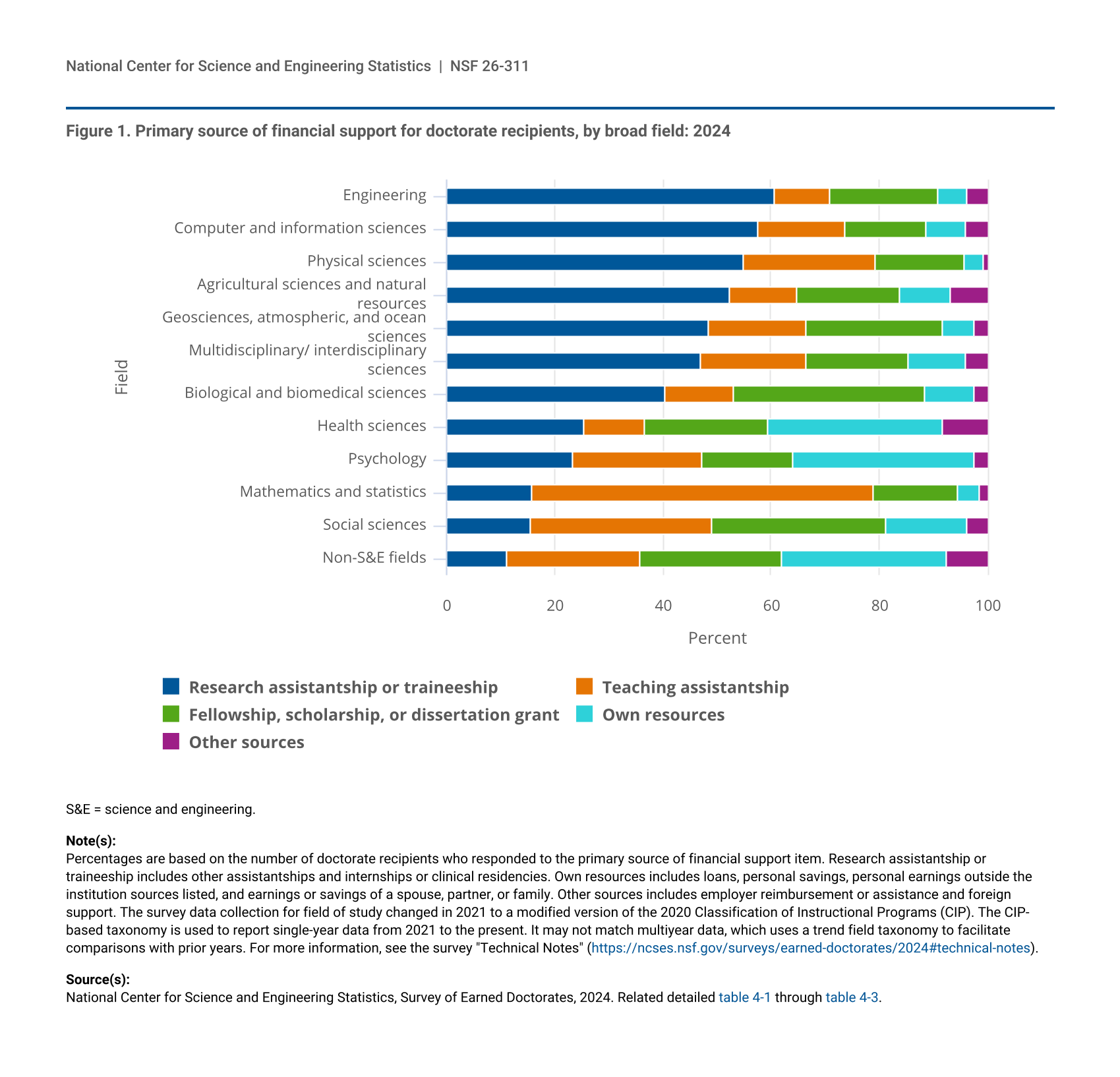
| Field | Research assistantship or traineeship | Teaching assistantship | Fellowship, scholarship, or dissertation grant | Own resources | Other sources |
|---|---|---|---|---|---|
| Engineering | 60.6 | 10.3 | 20.0 | 5.3 | 3.7 |
| Computer and information sciences | 57.7 | 15.9 | 14.9 | 7.5 | 4.0 |
| Physical sciences | 54.9 | 24.4 | 16.3 | 3.6 | 0.9 |
| Agricultural sciences and natural resources | 52.3 | 12.4 | 19.0 | 9.5 | 6.9 |
| Geosciences, atmospheric, and ocean sciences | 48.6 | 17.8 | 25.2 | 5.9 | 2.4 |
| Multidisciplinary/ interdisciplinary sciences | 47.0 | 19.4 | 19.0 | 10.5 | 4.1 |
| Biological and biomedical sciences | 40.3 | 12.8 | 35.2 | 9.2 | 2.5 |
| Health sciences | 25.3 | 11.2 | 22.9 | 32.2 | 8.3 |
| Psychology | 23.4 | 23.9 | 16.6 | 33.6 | 2.4 |
| Mathematics and statistics | 15.8 | 63.1 | 15.4 | 4.1 | 1.6 |
| Social sciences | 15.4 | 33.6 | 32.2 | 14.9 | 4.0 |
| Non-S&E fields | 11.2 | 24.5 | 26.3 | 30.3 | 7.7 |
S&E = science and engineering.
Percentages are based on the number of doctorate recipients who responded to the primary source of financial support item. Research assistantship or traineeship includes other assistantships and internships or clinical residencies. Own resources includes loans, personal savings, personal earnings outside the institution sources listed, and earnings or savings of a spouse, partner, or family. Other sources includes employer reimbursement or assistance and foreign support. The survey data collection for field of study changed in 2021 to a modified version of the 2020 Classification of Instructional Programs (CIP). The CIP-based taxonomy is used to report single-year data from 2021 to the present. It may not match multiyear data, which uses a trend field taxonomy to facilitate comparisons with prior years. For more information, see the survey "Technical Notes" (https://ncses.nsf.gov/surveys/earned-doctorates/2024#technical-notes).
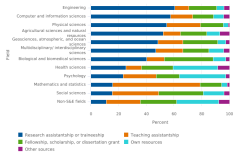
The majority of doctorate recipients receive funding from research assistantships or traineeships; teaching assistantships; and fellowships, scholarships, or dissertation grants, but the primary financial support varies by broad field. In 2024, research assistantships or traineeships were the most prevalent primary source of financial support for doctorate recipients in most broad fields and particularly in engineering (61%); computer and information sciences (58%); physical sciences (55%); agricultural sciences and natural resources (52%); geosciences, atmospheric, and ocean sciences (49%); multidisciplinary/interdisciplinary sciences (47%); and biological and biomedical sciences (40%). Teaching assistantships were the most frequent primary funding in mathematics and statistics (63%) and social sciences (34%). About one-third of doctorate recipients in psychology (34%), health sciences (32%), and non-science and engineering fields (30%) reported that the most common primary funding was their own resources. The proportion of doctorate recipients reporting fellowships, scholarships, and dissertation grants ranged between 15% and 35% in each broad field.
NCSES has reviewed this product for unauthorized disclosure of confidential information and approved its release (NCSES-DRN25-067).
Suggested citation: National Center for Science and Engineering Statistics (NCSES). 2026. Research Assistantships Are Doctorate Recipients’ Most Common Source of Primary Support in Most Fields. NSF 26-311. Alexandria, VA: U.S. National Science Foundation. Available at https://ncses.nsf.gov/pubs/nsf26311.