An official website of the United States government


Federal R&D Obligations Increased 4.4% in FY 2024; Most Agencies Estimate Declines in FY 2025
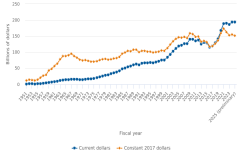
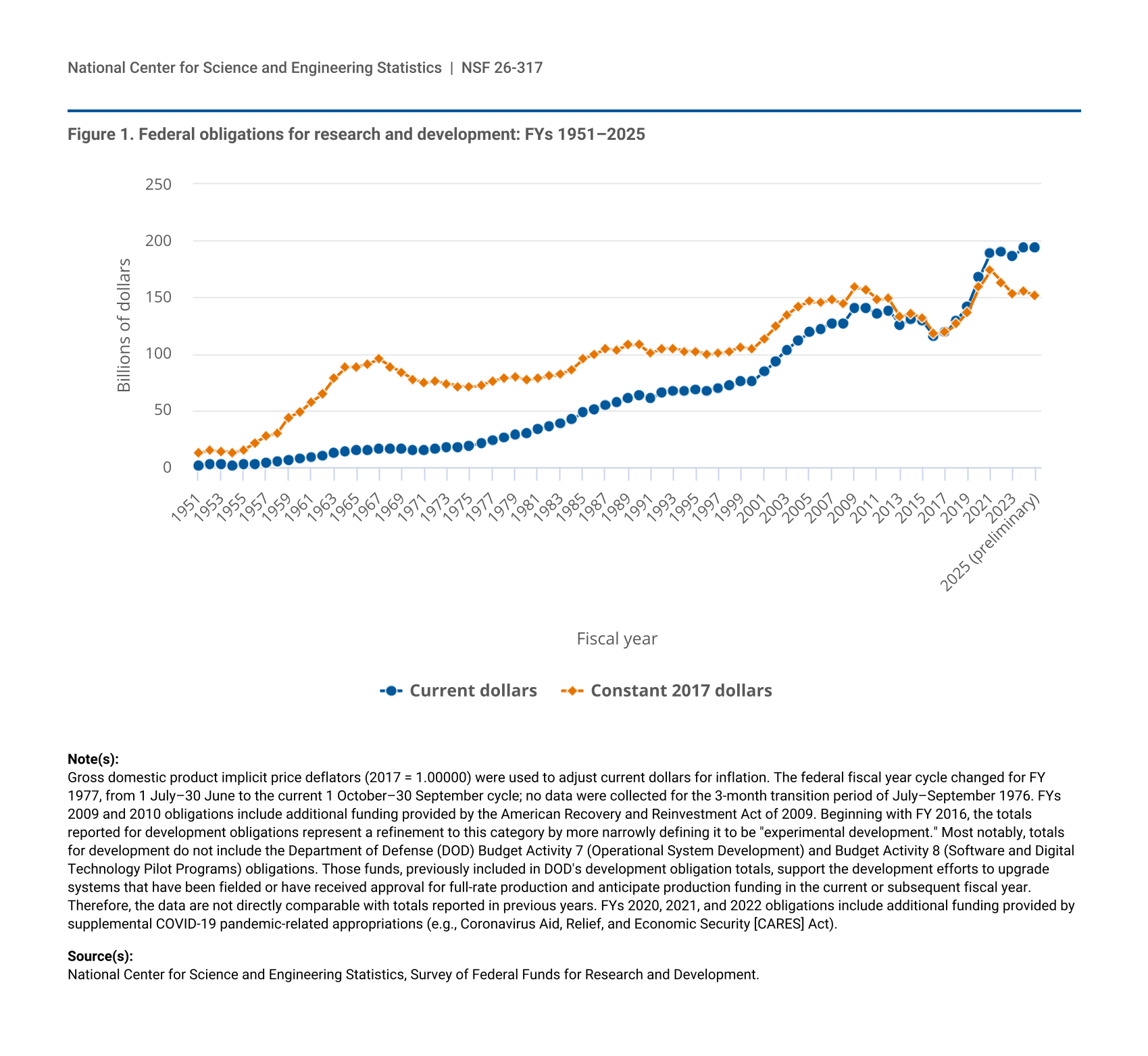
Federal agency obligations for research and experimental development (R&D) increased 4.4% from FY 2023 to FY 2024 ($186.1 billion to $194.2 billion) (figure 1). However, preliminary data for FY 2025 estimate federal agency obligations for R&D are relatively unchanged from FY 2024, decreasing by 0.1% to $194.1 billion. When adjusted for inflation, the FY 2024 amount increased 1.7% from FY 2023, and the FY 2025 amount is expected to decrease 2.3% from the previous year.
| Fiscal year | Current dollars | Constant 2017 dollars |
|---|---|---|
| 1951 | 1.5 | 12.0 |
| 1952 | 2.5 | 14.5 |
| 1953 | 1.9 | 14.3 |
| 1954 | 1.8 | 13.0 |
| 1955 | 2.0 | 14.9 |
| 1956 | 3.0 | 21.3 |
| 1957 | 3.9 | 27.0 |
| 1958 | 4.6 | 30.4 |
| 1959 | 6.7 | 43.9 |
| 1960 | 7.6 | 48.8 |
| 1961 | 9.1 | 57.8 |
| 1962 | 10.3 | 65.0 |
| 1963 | 12.5 | 78.0 |
| 1964 | 14.2 | 87.8 |
| 1965 | 14.6 | 88.6 |
| 1966 | 15.3 | 90.9 |
| 1967 | 16.5 | 95.2 |
| 1968 | 15.9 | 88.6 |
| 1969 | 15.6 | 83.2 |
| 1970 | 15.3 | 77.5 |
| 1971 | 15.5 | 74.7 |
| 1972 | 16.5 | 75.7 |
| 1973 | 16.8 | 73.9 |
| 1974 | 17.4 | 71.5 |
| 1975 | 19.0 | 70.9 |
| 1976 | 20.8 | 72.3 |
| 1977 | 23.5 | 76.1 |
| 1978 | 25.8 | 78.6 |
| 1979 | 28.1 | 79.2 |
| 1980 | 29.8 | 77.2 |
| 1981 | 33.1 | 78.0 |
| 1982 | 36.4 | 80.3 |
| 1983 | 38.7 | 81.7 |
| 1984 | 42.2 | 86.1 |
| 1985 | 48.4 | 95.4 |
| 1986 | 51.4 | 99.2 |
| 1987 | 55.3 | 104.2 |
| 1988 | 56.8 | 103.7 |
| 1989 | 61.4 | 107.8 |
| 1990 | 63.6 | 107.7 |
| 1991 | 61.3 | 100.3 |
| 1992 | 65.6 | 104.7 |
| 1993 | 67.3 | 105.0 |
| 1994 | 67.2 | 102.6 |
| 1995 | 68.2 | 101.9 |
| 1996 | 67.7 | 99.2 |
| 1997 | 69.8 | 100.6 |
| 1998 | 72.1 | 102.6 |
| 1999 | 75.3 | 105.9 |
| 2000 | 75.9 | 104.5 |
| 2001 | 84.5 | 113.6 |
| 2002 | 93.7 | 124.1 |
| 2003 | 103.5 | 134.5 |
| 2004 | 112.1 | 142.1 |
| 2005 | 118.8 | 146.2 |
| 2006 | 121.7 | 145.1 |
| 2007 | 127.3 | 147.6 |
| 2008 | 127.1 | 144.4 |
| 2009 | 141.1 | 158.7 |
| 2010 | 140.4 | 156.5 |
| 2011 | 135.5 | 148.2 |
| 2012 | 138.5 | 148.7 |
| 2013 | 125.7 | 132.6 |
| 2014 | 130.6 | 135.2 |
| 2015 | 128.8 | 132.0 |
| 2016 | 115.8 | 117.8 |
| 2017 | 119.0 | 119.0 |
| 2018 | 129.4 | 126.6 |
| 2019 | 142.4 | 136.8 |
| 2020 | 167.4 | 158.7 |
| 2021 | 189.6 | 173.8 |
| 2022 | 190.5 | 163.2 |
| 2023 | 186.1 | 152.4 |
| 2024 | 194.2 | 155.0 |
| 2025 (preliminary) | 194.1 | 151.5 |
Gross domestic product implicit price deflators (2017 = 1.00000) were used to adjust current dollars for inflation. The federal fiscal year cycle changed for FY 1977, from 1 July–30 June to the current 1 October–30 September cycle; no data were collected for the 3-month transition period of July–September 1976. FYs 2009 and 2010 obligations include additional funding provided by the American Recovery and Reinvestment Act of 2009. Beginning with FY 2016, the totals reported for development obligations represent a refinement to this category by more narrowly defining it to be "experimental development." Most notably, totals for development do not include the Department of Defense (DOD) Budget Activity 7 (Operational System Development) and Budget Activity 8 (Software and Digital Technology Pilot Programs) obligations. Those funds, previously included in DOD's development obligation totals, support the development efforts to upgrade systems that have been fielded or have received approval for full-rate production and anticipate production funding in the current or subsequent fiscal year. Therefore, the data are not directly comparable with totals reported in previous years. FYs 2020, 2021, and 2022 obligations include additional funding provided by supplemental COVID-19 pandemic-related appropriations (e.g., Coronavirus Aid, Relief, and Economic Security [CARES] Act).
National Center for Science and Engineering Statistics, Survey of Federal Funds for Research and Development.
The FY 2024 increase is due, in large part, to increases in R&D obligations from the Department of Defense (DOD), which saw obligations rise 14.4% from FY 2023 ($85.5 billion to $97.9 billion). However, the effect of these increases on the federal-wide R&D portfolio are partially offset by decreases in R&D obligations by the Department of Health and Human Services (HHS). In FY 2024, HHS saw obligations decline by 7.1% from FY 2023 ($52.5 billion to $48.8 billion). Although most agencies expect declines in R&D obligations in FY 2025—particularly in some of the agencies with larger R&D obligations, such as DOD, HHS, Department of Energy (DOE), and the U.S. National Science Foundation (NSF)—these are estimated to be offset by increased R&D obligations from the Department of Commerce (DOC). This InfoBrief will provide additional details and context regarding these trends and the unique circumstances accompanying federal funding for R&D in FY 2024 and FY 2025.
Data are from the latest cycle of the Survey of Federal Funds for Research and Development (Federal Funds for R&D), sponsored by the National Center for Science and Engineering Statistics (NCSES) within NSF. Data for FY 2024 are actual amounts as of the fiscal year end. FY 2025 data are preliminary and subject to revision in future surveys. Data presented in this InfoBrief are in current dollars unless noted otherwise.
FY 2024 Federal R&D Obligations
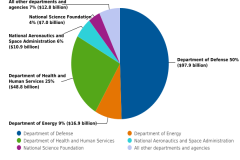
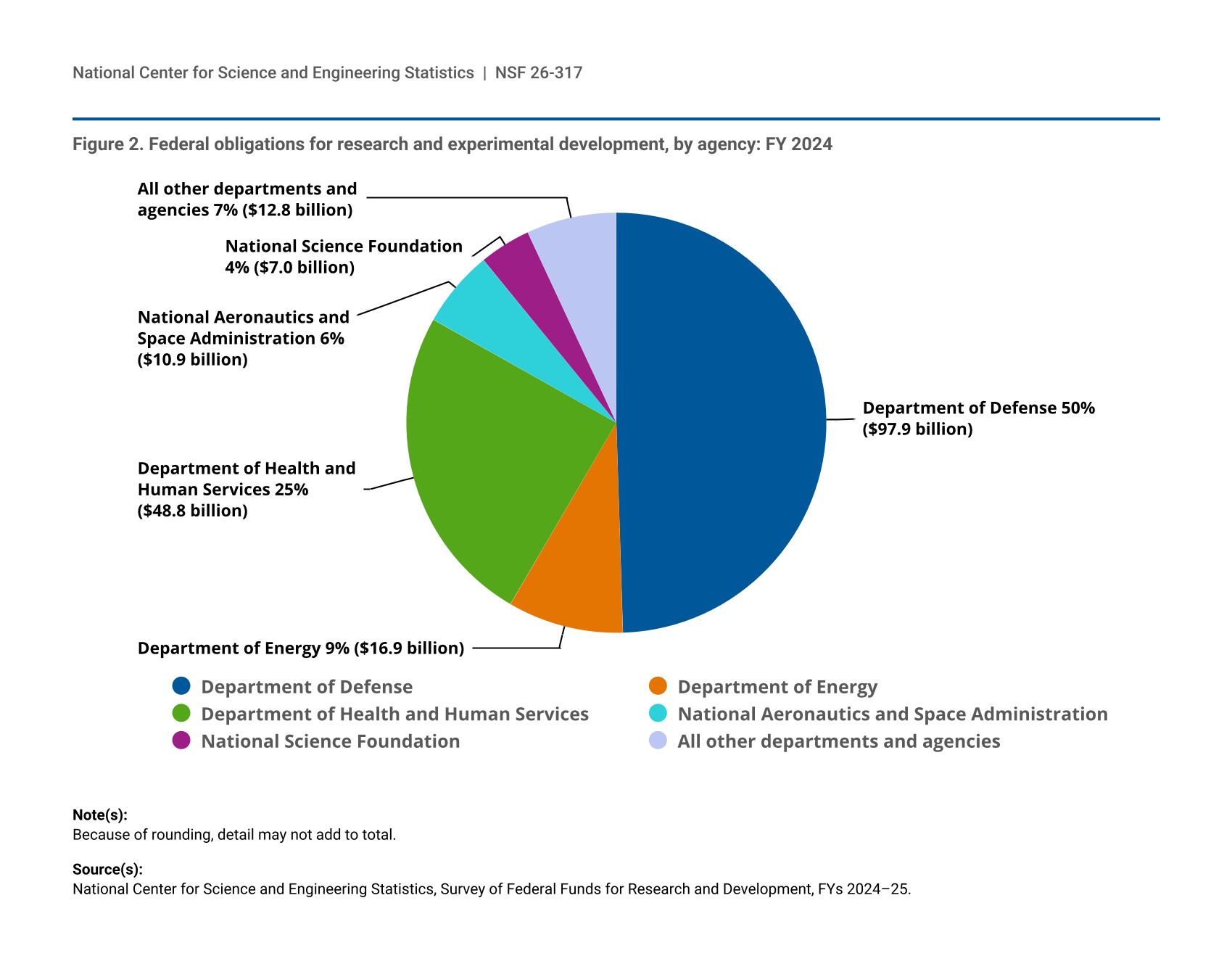
In FY 2024, the five federal agencies that traditionally have the largest R&D obligations (namely, DOD, HHS, DOE, the National Aeronautics and Space Administration [NASA], and NSF) accounted for 93% ($181.4 billion) of the total federal-wide R&D portfolio (figure 2). DOD and HHS were the two largest contributors to federal R&D obligations in FY 2024, accounting for 50% ($97.9 billion) and 25% ($48.8 billion), respectively. DOE was third at nearly 9% ($16.9 billion), followed by NASA at 6% ($10.9 billion) and NSF at 4% ($7.0 billion). All other departments and agencies account for 7% ($12.8 billion) of total federal R&D.
| Department or agency | Percent | Billions of dollars |
|---|---|---|
| Department of Defense | 50 | 97.9 |
| Department of Energy | 9 | 16.9 |
| Department of Health and Human Services | 25 | 48.8 |
| National Aeronautics and Space Administration | 6 | 10.9 |
| National Science Foundation | 4 | 7.0 |
| All other departments and agencies | 7 | 12.8 |
Because of rounding, detail may not add to total.
National Center for Science and Engineering Statistics, Survey of Federal Funds for Research and Development, FYs 2024–25.
Although the total R&D obligations increased by 4.4%, or $8.2 billion, from FY 2023, most of this increase was driven by DOD. In FY 2024, DOD alone increased 14.4%, or $12.3 billion, from the prior fiscal year. This trend is consistent with changes in budget authority for DOD’s research, development, test, and evaluation (RDT&E) programs from FY 2022 to FY 2023, which often take 1 or 2 years to make it from appropriation to obligation. Although R&D is a subset of DOD’s total RDT&E funding, there are similarities in the trends between the budget authority for RDT&E and the obligations for R&D. For example, DOD’s budget authority for RDT&E funding increased 17.6% from FY 2022 to FY 2023. DOD also had an 8.4% increase in RDT&E obligations from $133.3 billion in FY 2023 to $144.4 billion in FY 2024. The Congressional Budget Office (CBO) has also noted the purposes of the increases in DOD’s RDT&E account are to shift funding toward weapons systems for more conventional warfare. According to the CBO, “Since the mid-2010s, RDT&E has accounted for a steadily increasing share of acquisition funding, reaching 46 percent in 2023. That increase is the result of [DOD] changing its focus from procuring weapons for counterinsurgency operations to developing new weapons for potential conflicts against adversaries with advanced military capabilities.”
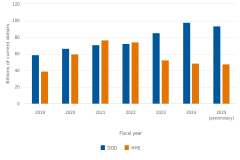
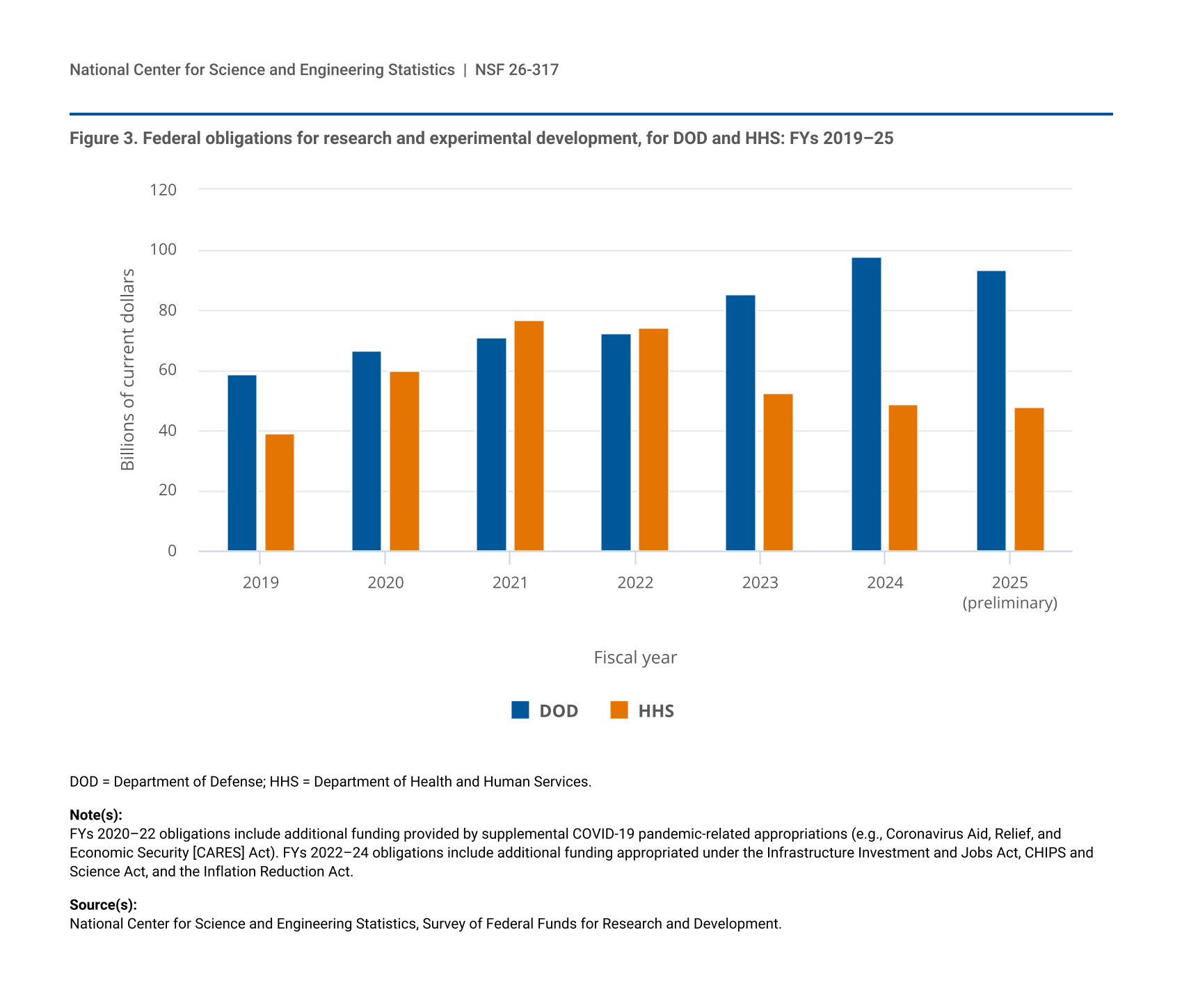
Although DOD’s R&D obligations increased from FY 2023 and FY 2024, the second-largest agency in terms of total R&D obligations, HHS, decreased 7.1%, or $3.7 billion, during that period ($52.5 billion to $48.8 billion) (figure 3). The National Institutes of Health (NIH), an agency within HHS, accounted for 91% of HHS’s total R&D obligations in FY 2024, and NIH saw an increase of 1.2% from FY 2023 to FY 2024. The single-largest contributing factor to the HHS decreases in FY 2024 was attributable to the decline in R&D obligations by the Biomedical Advanced Research Development Authority (BARDA) within HHS. BARDA’s R&D obligations increased substantially during the COVID-19 pandemic, rising from $736 million in FY 2019 to $15.7 billion in FY 2020 to $33.9 billion in FY 2021. However, the obligations declined 16.1% to $28.4 billion in FY 2022, declined a further 79.2% to $5.9 billion in FY 2023, and declined an another 74.8% in FY 2024 to $1.5 billion. Although other HHS component units had modest increases in R&D obligations from FY 2023 to FY 2024—for example, NIH increased from $44.0 billion to $44.5 billion, and the newly established Advanced Research Projects Agency for Health increased from $794 million to $1.0 billion—these were not enough to offset the $4.4 billion decrease from BARDA.
| Fiscal year | DOD | HHS |
|---|---|---|
| 2019 | 58.8 | 39.2 |
| 2020 | 66.7 | 60.0 |
| 2021 | 70.7 | 76.7 |
| 2022 | 72.4 | 74.1 |
| 2023 | 85.5 | 52.5 |
| 2024 | 97.9 | 48.8 |
| 2025 (preliminary) | 93.4 | 47.7 |
DOD = Department of Defense; HHS = Department of Health and Human Services.
FYs 2020–22 obligations include additional funding provided by supplemental COVID-19 pandemic-related appropriations (e.g., Coronavirus Aid, Relief, and Economic Security [CARES] Act). FYs 2022–24 obligations include additional funding appropriated under the Infrastructure Investment and Jobs Act, CHIPS and Science Act, and the Inflation Reduction Act.
National Center for Science and Engineering Statistics, Survey of Federal Funds for Research and Development.
Although the end of the COVID-19 pandemic-related funding drove the FY 2024 decrease in HHS’s R&D obligations, the FY 2024 increases from DOD can be attributed to interests in ensuring national defense preparedness. This has resulted in federal R&D obligations rebounding 4.4% in FY 2024, after a 2.3% decrease in FY 2023.
FY 2025 Estimated Federal R&D Obligations
Based on preliminary data for FY 2025, federal agency obligations for R&D are estimated to decrease by 0.1% to $194.1 billion (table 1). With the passage of the Full-Year Continuing Appropriations and Extension Act, 2025, Public Law (P.L. 119-4), most agencies appropriations were set at the amounts from FY 2024. As such, data users might expect to see the FY 2025 estimated R&D obligations to be similar to the FY 2024 levels. However, an analysis of the FY 2025 preliminary estimates reveals a more nuanced data narrative.
Because of rounding, detail may not add to total. FYs 2020, 2021, and 2022 obligations include additional funding provided by supplemental COVID-19 pandemic-related appropriations (e.g., Coronavirus Aid, Relief, and Economic Security [CARES] Act). See technical table A-2 for additional notes associated with the agencies listed in this table.
National Center for Science and Engineering Statistics, Survey of Federal Funds for Research and Development.
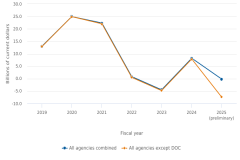
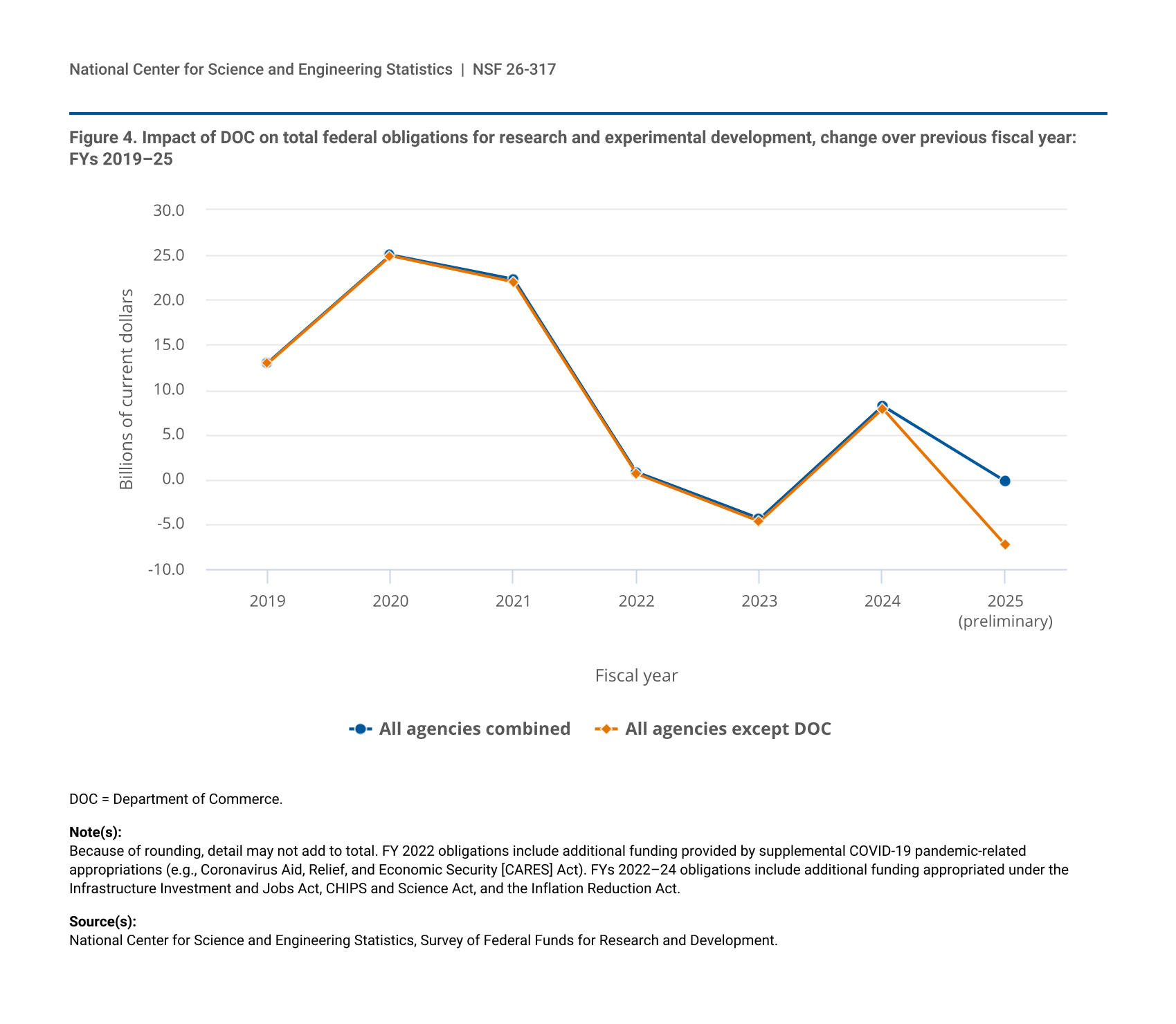
In FY 2025, DOD estimates R&D obligations to decline by 4.6% from FY 2024 ($97.9 billion to $93.4 billion). Similarly, HHS estimates a decline of 2.2% during this period ($48.8 billion to $47.7 billion). At the same time, DOE and NSF are expected to decrease 5.1% and 2.4%, respectively. NASA is the only one among the traditional five largest agencies by R&D obligations to remain flat at $10.9 billion for both years. Combined, these five agencies show an overall decline of 3.6% from FY 2024 to FY 2025 ($181.4 billion to $174.9 billion). And yet, the total federal R&D obligations for FY 2025 show a decline of just $187 million. This is mainly due to an estimated 263% increase for DOC in FY 2025 ($2.7 billion to $9.8 billion). To better illustrate the effect of the DOC increase on total federal R&D obligations, if DOC is removed from the data set, R&D obligations would decrease $7.4 billion from FY 2024 to FY 2025, as opposed to declining $187 million when DOC is included (figure 4).
| Fiscal year | All agencies combined | All agencies except DOC |
|---|---|---|
| 2019 | 13.0 | 12.9 |
| 2020 | 25.0 | 24.9 |
| 2021 | 22.3 | 22.0 |
| 2022 | 0.8 | 0.6 |
| 2023 | -4.4 | -4.7 |
| 2024 | 8.2 | 7.9 |
| 2025 (preliminary) | -0.2 | -7.3 |
DOC = Department of Commerce.
Because of rounding, detail may not add to total. FY 2022 obligations include additional funding provided by supplemental COVID-19 pandemic-related appropriations (e.g., Coronavirus Aid, Relief, and Economic Security [CARES] Act). FYs 2022–24 obligations include additional funding appropriated under the Infrastructure Investment and Jobs Act, CHIPS and Science Act, and the Inflation Reduction Act.
National Center for Science and Engineering Statistics, Survey of Federal Funds for Research and Development.
The increase in the DOC’s R&D obligations in FY 2025 have their origins 3 years earlier. In 2022, three bills signed into law authorized additional supplemental appropriations, some of which were directed toward funding R&D. Federal agency obligations from Public Law (P.L.) 117-58 and P.L. 117-169 contributed an additional $681 million and $125 million, respectively, to the FY 2025 totals. However, obligations originating from P.L. 117-167 increased the law’s contribution to the total federal R&D portfolio from $740 million in FY 2024 to $8.0 billion in FY 2025. Most of this increase in R&D obligations by DOC from P.L. 117-167 were passed through the National Institute of Standards and Technology, an agency within the DOC, whose R&D obligations increased from $1.3 billion in FY 2024 to an estimated $8.0 billion in FY 2025.
In summary, although most federal agencies estimate declining R&D obligations for FY 2025, the effect of supplemental appropriations continue to keep FY 2025 levels similar to those of FY 2024.
Data Sources, Limitations, and Availability
Federal Funds for R&D is a census of all federal agencies that fund R&D programs, as identified from information in the president’s budget submission to Congress, excluding the Central Intelligence Agency and the National Security Agency. Federal agencies that fund R&D are identified in Analytical Perspectives, Budget of the United States Government, Fiscal Year 2024. Data were obtained from 29 federal agencies (14 federal departments and 15 independent agencies) that had obligations for R&D during FY 2024 or FY 2025. Because multiple subdivisions of some federal departments completed the survey, there were agency-level responses from 6 federal departments, 46 agencies (within another 8 federal departments), and 15 independent agencies. However, lower offices could also be authorized to enter data. In Federal Funds for R&D nomenclature, agency-level offices could authorize program offices, program offices could authorize field offices, and field offices could authorize branch offices. When these suboffices are included, there were 571 total respondents: 67 agencies, 110 program offices, 188 field offices, and 206 branch offices.
Volume 74 of Federal Funds for R&D collected final FY 2024 data and preliminary FY 2025 totals. FY 2025 data are subject to revision when collected under next year’s survey, volume 75 (FY 2025 data and preliminary FY 2026 totals). Percentages presented in this report are calculated based on unrounded data and may differ slightly from what are presented in the tables and figures in this InfoBrief.
Beginning with volume 66 of the survey (FY 2016 and FY 2017), the totals reported for development obligations and outlays represent a refinement to this category by more narrowly defining it to be “experimental development” to align with federal R&D budget formulation as per the Office of Management and Budget’s Circular A-11, Section 84. As a result, totals for experimental development from FY 2016 and on do not include DOD Budget Activity 7 (Operational System Development) and Budget Activity 8 (Software and Digital Technology Pilot Programs) obligations and outlays. Those funds, previously included in DOD’s development totals, support the development efforts to upgrade systems that have been fielded or have received approval for full-rate production and anticipate production funding in the current or subsequent fiscal year. Therefore, the development data and total R&D data are not directly comparable with totals reported prior to FY 2016. Although this survey is a census of federal agencies that fund R&D and there is no sampling error, survey data are still subject to some degree of unmeasured nonsampling error, which may include errors in classification or measurement of certain aspects of an agency’s R&D. For additional information see the section “Survey Quality Measures” within the Technical Notes of the survey.
The full set of data tables for FY 2024 and FY 2025 are available at https://ncses.nsf.gov/surveys/federal-funds-research-development/2024-2025. For more information, please contact NCSES.
NCSES has reviewed this product for unauthorized disclosure of confidential information and approved its release (NCSES-DRN26-001).
Notes
1 Obligations represent the amount for orders placed, contracts awarded, services received, and similar transactions during a given period, regardless of when the funds were appropriated or when future payment of money is required.
2 Gross domestic product implicit price deflators were used to convert current dollars to constant 2017 dollars. Data on federal fiscal year historical figures, 1951–2024, can be found in: Office of Management and Budget (OMB). 2025. Budget of the U.S. Government, Fiscal Year 2025. Historical Tables. Table 10.1. Gross Domestic Product and Deflators Used in the Historical Tables: 1940–2029. Available at https://www.govinfo.gov/app/details/BUDGET-2025-TAB/BUDGET-2025-TAB-11-1/context.
3 For specific agency details, see the full set of data tables: table 73.
4 Although year-to-year trend data are presented in this report to the tenth place, data presented as a percentage share are presented as rounded whole-percents.
5 For specific R&D obligations by the Department of Defense, see the full set of data tables: table 73.
6 Budget authority is the primary source of legal authorization to enter into obligations that will result in future outlays.
7 For more data on DOD RDT&E budget authority, see Federal R&D Funding, by Budget Function: Fiscal Years 2022–24: table 6.
8 For more data on DOD RDT&E obligations data, see the full set of data tables: table 10.
9 Congressional Budget Office. 2023. Long-Term Implications of the 2024 Future Years Defense Program, p. 19. Available at https://www.cbo.gov/system/files/2023-10/59511-FYDP.pdf.
10 For specific R&D obligations by NIH, see the full set of data tables: table 73.
11 For specific R&D obligations by the BARDA, see the full set of data tables: table 73.
12 Specifically, Public Laws 117-58, 117-167, and 117-169.
13 For reported R&D obligations from Public Laws 117-58, 117-167, and 117-169, contact NCSES for additional details.
14 For specific data on R&D obligations by the National Institute for Standards and Technology in FY 2024 and FY 2025, see the full set of data tables: tables 5 and 6, respectively.
15 No Analytical Perspective on R&D for the FY 2025 Budget of the United States was issued by the Office of Management and Budget. As such, NCSES relied on data from chapter 6, Research and Development, Analytical Perspectives, Budget of the United States Government, Fiscal Year 2024. Available at https://www.govinfo.gov/content/pkg/BUDGET-2024-PER/pdf/BUDGET-2024-PER.pdf.
16 See Section 84, Character Classification (Schedule C), Circular A-11: Preparation, Submission, and Execution of the Budget. Available at https://bidenwhitehouse.archives.gov/wp-content/uploads/2018/06/a11.pdf.
17 For additional information, see National Center for Science and Engineering Statistics (NCSES). 2021. Statistical Definition of Development Clarified: Effect on Reported Federal R&D Totals. NSF 21-326. Alexandria, VA: U.S. National Science Foundation. Available at https://ncses.nsf.gov/pubs/nsf21326/.
18 Survey Technical Notes are available at https://ncses.nsf.gov/surveys/federal-funds-research-development/2024-2025#methodology.
Suggested Citation
National Center for Science and Engineering Statistics (NCSES). 2026. Federal R&D Obligations Increased 4.4% in FY 2024; Most Agencies Estimate Declines in FY 2025. NSF 26-317. Alexandria, VA: U.S. National Science Foundation. Available at https://ncses.nsf.gov/pubs/nsf26317.
Contact Us
National Center for Science and Engineering Statistics
Directorate for Social, Behavioral and Economic Sciences
U.S. National Science Foundation
Tel: (703) 292-8780
FIRS: (800) 877-8339
TDD: (800) 281-8749
E-mail: ncsesweb@nsf.gov