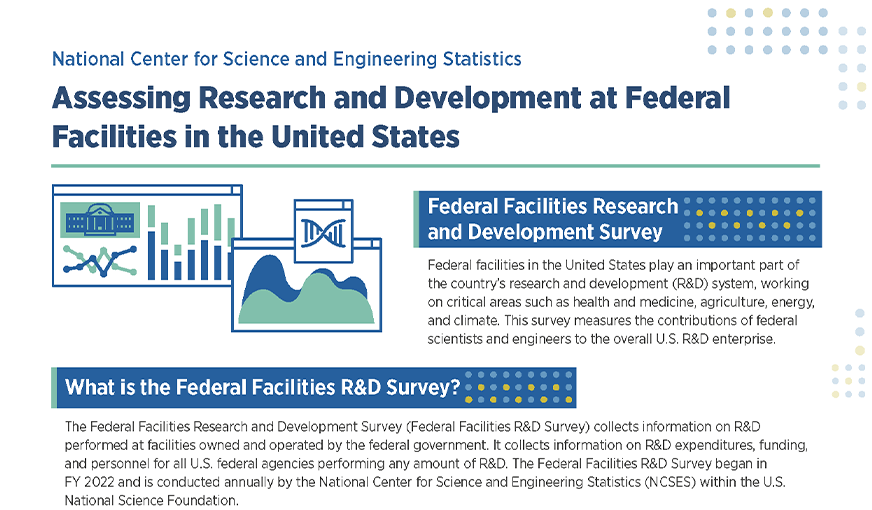
Purpose. The Federal Facilities Research and Development (FFRD) Survey collects information on research and experimental development (R&D) expenditures and personnel for all federally owned and operated facilities in the United States. This survey is the unique source of federal performer-reported data on R&D expenditures and R&D personnel. In conjunction with performer-reported data for the remaining sectors of the economy, FFRD Survey data can be used to estimate total national R&D performance and other critical statistics that are increasingly important in the analysis of global R&D competitiveness.
Data collection authority. The information is solicited under the authority of the National Science Foundation Act of 1950, as amended, and the America COMPETES Reauthorization Act of 2010. NCSES has reviewed this product for unauthorized disclosure of confidential information and approved its release (NCSES-DRN25-004).
Survey contractor. ICF.
Survey sponsor. The FFRD Survey is sponsored by the National Center for Science and Engineering Statistics (NCSES) within the U.S. National Science Foundation.
Target population. The population for the FY 2024 FFRD Survey consisted of federally owned and operated facilities in the United States that performed R&D in FY 2024, excluding facilities of the Central Intelligence Agency (due to the classified nature of their work). Federally funded research and development centers (FFRDCs) are surveyed separately in the FFRDC R&D Survey, and University Affiliated Research Centers (federally funded but not federally owned or operated) are surveyed as part of the Higher Education Research and Development Survey.
Sampling frame. The facilities for the FY 2024 FFRD Survey were originally identified from the list of federal agencies with R&D obligations based on the Survey of Federal Funds for R&D and the Federal Laboratory Consortium list of laboratories. A facility is defined as a unit within an agency that is responsible for performing R&D, generally with its own distinct budget and leadership. Since each agency has a different organizational structure, this unit of measurement may be a division, branch, center, laboratory, or other entity and may span multiple locations. For FY 2024, the frame was updated by (1) removing records ineligible during the FY 2022 survey, (2) adding records having federal R&D obligations as reported in the Survey of Federal Funds for R&D, and (3) adding, removing, and adjusting reporting levels based on communications with agency contacts. The total number of reporting units for the FY 2024 FFRD Survey is 322, which represents the 454 research-performing federal facilities.
Sample design. Not applicable.
Data collection. Data collection began with an e-mail to each agency to verify the reporting units and to confirm or identify the name, phone number, and e-mail address of each facility-level respondent. Table A-1 displays a list of facilities within each agency and notes which are reporting units for the FY 2024 FFRD Survey. When the reporting units are totaled, there are 300 total units across 36 agencies. There were 12 agency-level responses and 275 responses at a level lower than the agency-level for a total of 287 responses. Twenty-two reporting units were determined ineligible, including one entire agency.
Respondents could choose to submit a questionnaire downloaded from the Web or sent via e-mail (i.e., PDF or Excel format) or use a Web-based data collection system to respond to the survey. Questionnaires were carefully examined for completeness upon receipt. Respondents were sent personalized e-mail messages asking them to provide any necessary revisions before the final processing and tabulation of data. These e-mail messages included a link to the FFRD Survey Web-based collection system, allowing respondents to view and correct their data online. Respondents were also offered the opportunity to explain their data or provide corrections via e-mail, through PDF, or through Excel and have their data updated by survey staff.
Data collection began on 22 January 2025, and the requested due date for data submissions was 31 March 2025. Data collection was extended until most surveyed agencies provided at least partial data with the last completed survey response verified in May 2025.
Mode. Respondents could choose to submit a questionnaire via the Web-based data collection system or through fillable PDFs or Excel files that were then imported to the Web-based data collection system. All edit and trend checks were accomplished through the Web-based system. Five facilities submitted data using the fillable PDF, 148 facilities submitted using an Excel version of the survey, and 134 submitted using the Web-based data collection system.
Response rates. By the survey’s closing date in May 2025, forms had been received from 287 facilities out of an eligible population of 300, a response rate of 95.7%. Table A-2 displays a detailed breakdown of response rates by Department of Defense (DOD) and non-DOD agencies, and table A-3 displays a breakdown of response rates for each survey question. Questions 9 and 10 had much lower response rates for non-DOD agencies and were the only questions with response rates less than 100% for DOD agencies. Questions 9 and 10 asked facilities to report headcounts for R&D personnel by function and job category (Question 9) and federal full-time equivalents (FTEs) by function (Question 10).
Data editing. Data inconsistencies or blank fields in the FFRD Survey were flagged automatically by the Web-based data collection system so that respondents could not submit their final data until all required fields were completed without errors. Respondents were contacted and asked to resolve possible self-reporting issues themselves. Questionnaires were carefully examined by survey staff upon receipt. Reviews focused on unexplained missing data, expenditures that significantly differed from the FY 2022 FFRD Survey, expenditures that significantly differed from the intramural obligations from the Survey of Federal Funds for R&D, and other data anomalies. If additional explanations or data revisions were needed, respondents were sent personalized e-mail messages asking them to provide any necessary revisions before the final processing and tabulation of data. For any follow-up questions that went unanswered, NCSES was consulted before the data were either accepted without changes or adjusted based on information from other questions or previous contacts with the respondent.
The Federal Highway Administration (FHA) provided data outside of survey forms and provided partial data that the survey team added to the database with FHA’s approval. FHA provided total R&D intramural expenditures along with the distribution of R&D by federal and nonfederal sources. The survey team used FY 2022 data to estimate type of R&D for FY 2024 and other survey data points.
Imputation. Instances of missing data occurred when a facility did not respond to the survey (i.e., unit nonresponse) or when a facility responded but did not answer certain survey questions (i.e., item nonresponse). After removing 22 ineligible facilities, 300 total records remained, with 287 responses and 13 nonresponses. Among responding facilities, total R&D expenditures were completely observed (from Questions 1, 2, or 5 totals). The pattern of missing data showed that 67% of facilities have complete data across all variables selected for imputation. Personnel items are missing for 12% of facilities, and 4% of facilities are missing only the R&D fields detail. Another 17% of facilities are missing some combination of personnel detail items or expenditure detail items.
Imputed values are not displayed at the facility level; these are replaced with “NA” in the tables. However, the imputed values are included in the agency, department, and overall totals.
The imputation process for the FY 2024 FFRD Survey is a combination of multiple imputation models, and deterministic proportional allocation were used for item totals and item details respectively. Auxiliary information from the FY 2022 FFRD Survey was used in modeling and calculation of proportions where appropriate. The imputation includes five main steps:
First, the total intramural R&D expenditures were estimated using a linear regression model with the expenditures from the FY 2022 FFRD Survey. The model included separate intercepts for each agency and log-transformed R&D totals. The U.S. Geological Survey was excluded from the imputation model due to the facility reporting a combined intramural and extramural total. The Department of the Air Force was excluded because total reported expenditures were substantially larger than other agencies and because it did not respond in FY 2022. Multiple imputation was used to create multiple sets (m = 5) of plausible values for the missing values. After imputing total onsite R&D expenditures, the imputed value was assigned to other fields representing the same value including total type of R&D-type expenditures (Question 4), total field of R&D expenditures (Question 5), and within facility costs (subset of Question 2).
Second, the intramural total R&D expenditures were then allocated to the subcategories of type of R&D, source of funding and federal agency source of funding, and field of R&D. Type of R&D and field of R&D were imputed for nonresponding facilities based on the percent distributions using the following information in order:
1. FY 2022 FFRD Survey observed distribution for the facility,
2. Responding FY 2024 facilities within the same agency aggregated to the agency level, and
3. Responding FY 2024 facilities within the same agency aggregated to the department level.
All imputed R&D amounts were assigned as a federal source of R&D. This follows the same procedure in FY 2022 based on the majority of R&D in FY 2024 coming from federal sources for each type (98% basic research, 97% applied research, and 99% experimental development).
Third, total R&D expenditures (Question 1) and personnel item totals (Questions 9 and 10) were imputed using Multivariate Imputation by Chained Equations (MICE). The multiple imputation is a two-stage nested version using additional n = 4 imputation sets for a total M = mn imputed data set (M = 20). For every imputation in the first type (e.g., R&D expenditures), additional imputations are created for the second type (e.g., personnel), holding the first imputed values fixed.
Fourth, after the second imputation model, the total R&D expenditures value was assigned to the cost type total (Question 2), since these two variables represent the same amount. R&D expenditures performed outside facilities (subset of Question 2) were calculated as the difference between total R&D expenditures and total R&D within facilities.
For DOD facilities, when some facilities within the agency responded (partial agency response), total research, development, testing, and evaluation (RDT&E) (Question 1) for nonresponding DOD facilities were imputed based on a ratio adjustment using the ratio of total expenditures at the agency level and applying it to the imputed R&D total for the facility. When no facilities responded within the agency surveyed by the FY 2024 FFRD Survey, the ratio adjustment was based on the department level from the FY 2024 FFRD Survey. Finally, operational system development expenditures were calculated as the difference between total RDT&E and total R&D.
Lastly, personnel (Questions 9 and 10) totals were allocated to function (i.e., researcher, technician, support) based on the percentage distribution using the following information in order:
1. FY 2022 FFRD Survey observed distribution for the facility,
2. Responding facilities within the same agency aggregated to the agency level,
3. Responding facilities within the same department aggregated to the department level, and
4. Responding facilities within the same DOD or non-DOD category aggregated to the DOD or non-DOD level.
The imputed job counts and FTE for federal employees, contractors, and other employment status for each role were summed to calculate the imputed total job count and FTE.
Weighting. Survey data were not weighted.
Sampling error. Because the FY 2024 survey was distributed to all eligible agencies performing R&D, there was no sampling error.
Coverage error. Under the total survey error framework, coverage error describes the difference between reporting units and units in the target population that the frame was developed to reach. The subset of agencies is based on those reporting non-zero intramural R&D obligations on the Survey of Federal Funds for R&D. Risk of coverage bias is small if an agency had federal R&D expenditures but did not have reported obligations.
Nonresponse error. Nonresponse error refers to the differences in key estimates between units (i.e., facilities) in the frame that were selected for data collection and those that responded. Of the 300 eligible reporting units, 287 responded for a response rate of 95.7%. For unit nonresponse, multiple follow-ups were conducted with nonresponding facilities, and multiple contact and data collection modes were used (i.e., phone and e-mail) to mitigate nonresponse error. The imputations include predictions of unit nonrespondents to reduce the risk of nonresponse bias in the final estimates.
The item response rate ranged from 93.0% to 100% for the DOD agencies and from 81.1% to 100% for the non-DOD agencies. For item nonresponse, facilities were encouraged to report estimates of expenditures when actual dollar amounts could not be provided. This approach reduces item nonresponse error risk but may introduce measurement error. Imputation was conducted to help mitigate item nonresponse error.
Measurement error. The FFRD Survey contained various ways for respondents to explain their answers. This included comment boxes for every question with instructions to provide additional information about how they calculated their response and any assumptions they made. Respondents were also prompted to enter comments if they indicated any data were unavailable. Additionally, questions requiring detailed reporting of personnel also included a checkbox to allow the respondent to indicate if they were able to provide the total number but were unable to provide details. The largest risk of measurement error is likely respondents’ interpretation of the definition of R&D activities and variations in record-keeping procedures used by respondents to answer the survey questions. In addition, other known measurement problems are known to exist in the data, as shown below.
- R&D expenditures. The survey included a question asking respondents to confirm if they were reporting expenditures. Not all facilities were able to report expenditure data and instead reported obligations. Twenty-nine facilities confirmed they could not report expenditures.
- Type of R&D. Some facilities said that these amounts were difficult to report either because they could not determine how best to allocate expenditures among the three categories or because they did not track information in that way.
- Military personnel salaries. In the prior study year, the study team heard from several facilities that military R&D personnel salary data can be difficult to report as it is often tracked separately from R&D expenditures. As such, several facilities that likely do have military personnel were unable to report salary and benefit expenditure data because they are unavailable.
Data revisions. Annual data are available for FY 2022. FY 2023 was not collected in an effort to improve the timing of the data collection. Moving forward, there are no plans to skip fiscal years.
In some cases, the review for consistency between the FY 2022 and FY 2024 submissions revealed significant differences due to facilities’ reappraisal of their classification of various aspects of R&D programs for FY 2024. In those instances, NCSES requested that facilities revise FY 2022 data to maintain consistency and comparability.
In cases where a response was not received in FY 2022 but was received in FY 2024, no revisions were made to the imputed FY 2022 totals. Caution should be used when comparing facility-level reported data in FY 2024 with the corresponding FY 2022 imputed amounts. The largest difference in imputed FY 2022 data and reported FY 2024 data is within the Department of the Air Force, where the FY 2024 reported amount was more than double the FY 2022 imputed amount. This was due to the large amount of R&D expenditures for onsite contractors, which was a category not able to be estimated in FY 2022.
For trend comparisons, use the historical data from only the most recent publication, which incorporates changes facilities have made in prior year data to reflect corrections. Do not use data published earlier.
Changes in survey coverage and population. For FY 2024, changes to the reporting units for four agencies are described below:
- Department of the Air Force. The survey team imputed data for likely R&D performers in FY 2022. Prior to the FY 2024 collection, the survey team identified respondents within the Air Force who identified all likely R&D performers. This changed the number of reporting units for Air Force from 5 to 12. However, during collection, 3 were deemed ineligible as they do not perform R&D within the facility.
- Space Force. As part of identifying Air Force reporting units, the Air Force agency-level contact informed the survey team that Space Force should be listed under the Air Force and not as its own agency under the Department of Defense. Additionally, it was determined that FY 2022 data did not include the correct Space Force reporting unit structure. This changed the number of reporting units for Space Force from 27 to 6. However, during collection, 2 were deemed ineligible as they did not perform R&D.
- National Oceanic and Atmospheric Administration. An agency-level respondent identified 11 facilities that do not conduct R&D within the facility and should not have been included in the
FY 2022 population. These facilities were removed from the FY 2022 totals in table 3:
- Office of the Chief Information Officer
- Office of the Chief Administrative Officer
- Marine and Aviation Operations Center
- U.S. Integrated Ocean Observing System
- Office of Habitat Conservation
- Greater Atlantic Region Fisheries Office
- West Coast Region
- Pacific Islands Regional Office
- Alaska Regional Office
- Southeast Regional Office
- Office of Water Prediction
- Smithsonian Institution. The survey team imputed data for likely R&D performers in FY 2022. Prior to the FY 2024 data collection, the survey team identified an agency-level respondent who identified all facilities within the Smithsonian Institution that perform R&D. This changed the number of reporting units from 6 to 22.
Changes in questionnaire. In FY 2024, the questionnaire was reorganized to ask for expenditures within the facility and outside of the facility at the beginning of the questionnaire versus separating it into two sections beginning with expenditures within the facility only.
Question 1 is new and requests total expenditures for R&D activities both within the facility by federal personnel or contractors and funding provided to others to conduct R&D outside the facility. The DOD version of Question 1 asks for total RDT&E by budget activity for RDT&E performed within and outside the facility.
Additionally, Section 2: R&D Funding to Other Organizations (FY 2022 Questions 6–8) was removed from the survey. The total funding provided to other organizations is now requested as part of new Question 2 that asks for R&D expenditures by types of costs including expenditures for onsite contractors, all other costs for R&D performed within the facility, and R&D expenditures for work performed outside the facility.
Question 3 is a new question that asks what is included in the total R&D expenditures within their facility with the following checkbox response options:
- Salaries and fringe benefits of federal R&D personnel, trainees, and fellows
- Salaries and fringe benefits of onsite contractors working on R&D
- Salaries and fringe benefits of military R&D personnel
- Indirect costs associated with R&D activities
- Costs for equipment, materials, and supplies necessary for the R&D activities
- Other
Additional funding agencies were added to Question 6, federal source of funding, reducing the number of write-in agencies.
When reporting personnel headcounts by job category on Question 9, facilities have the option to provide only total counts if a breakout by job category or function is not possible. Similarly, facilities can provide only total federal personnel FTE if a breakout by R&D function is not possible.
Facility. A unit within an agency that is responsible for performing R&D, generally with its own distinct budget and leadership. This may be a division, branch, center, laboratory, or other entity. The staff who work within the facility, and the facility itself, may be located in more than one physical location.
Fields of R&D. A list of the 56 fields of R&D reported on can be found on the survey questionnaire. In the data tables, the fields are grouped into 10 major areas: agricultural sciences and natural resources and conservation; biological, biomedical, and health sciences; computer and information sciences; geosciences, atmospheric sciences, and ocean sciences; mathematics and statistics; physical sciences; psychology; social sciences; engineering; and other fields.
Fiscal year. The federal government’s financial year: FY 2024 began 2023 October 1 and ended 2024 September 30.
Full-time equivalents (FTEs). Calculated as the total working effort spent on research during a specific period divided by the total effort representing a full-time schedule within the same period. FTE R&D personnel are federal employees and military personnel only.
Public-private partnerships. Those in which the government and private companies share R&D costs.
Research and experimental development (R&D). R&D is creative and systematic work undertaken in order to increase the stock of knowledge—including knowledge of humankind, culture, and society—and to devise new applications of available knowledge. R&D has five major features:
- Novel. Advances current knowledge or creates new knowledge
- Creative. Focuses on original concepts and hypotheses
- Uncertain. Outcomes are not completely determined at the outset of a project
- Systematic. Projects are planned and budgeted
- Transferable or reproducible. Methodology and results are transferable to or reproducible in other situations and locations
R&D also has three major types: basic research, applied research, and experimental development.
Research, development, testing, and evaluation (RDT&E). Exclusive to DOD, this consists of all the activities described above for R&D conduct plus:
- Operational system development (Budget Activity 7). Pre-production development of non-experimental work on a product or system before it goes into full production, including activities such as tooling and development of production facilities.
- Software and digital technology pilot programs (Budget Activity 8). Software, electronic tools, systems, applications, resources, acquisition of services, business process re-engineering activities, functional requirements development, technical evaluations, and other activities in direct support of acquiring, developing, deploying, sustaining, enhancing, and modernizing Software Digital Technology Pilot Programs.
R&D expenditures. Money the facility spent in FY 2024 for R&D projects both within and outside a facility. Expenditures are often referred to as outlays. Expenditures include labor costs for R&D projects; noncapital purchases of materials, supplies, equipment, and services to support R&D performance; general administration costs in support of R&D activities; and expenditures for funding provided to others to conduct R&D outside a facility.
- Total FY 2024 expenditures for R&D both within and outside a facility are collected in Question 1. This includes all of a facility's R&D expenditures, regardless of whether the funding was from direct appropriations, interagency agreements, reimbursable funds, or nonfederal sources; expenditures for R&D performed by the facility's employees; and expenditures for R&D performed within and outside the facility by contractors or other entities.
- Question 2 includes total FY 2024 expenditures for R&D separated by types of costs: (a) R&D expenditures for onsite contractors, (b) all other costs for R&D performed within the facility, (c) total R&D expenditures within the facility, (d) R&D expenditures for work performed outside the facility, and (e) total R&D expenditures.
- Question 4 and all questions that follow focus on total R&D expenditures within a facility reported in Question 2, row c.
Sources of R&D funding and type of organization.
- U.S. federal government. Any agency of the U.S. government. Federal funds that were passed through from another institution were included.
- State and local government. Any state, county, municipality, or other local government entity in the United States, not including funds from state and local universities and colleges or agricultural experiment stations.
- Business. Domestic or foreign for-profit businesses or industrial firms.
- Nonprofit organizations. Domestic or foreign nonprofit foundations and organizations, except universities and colleges.
- Higher education. Domestic higher education institutions, military service academies, and consortia.
- All other organizations. Sources not reported in other categories, such as funds from foreign governments.
Type of R&D.
- Basic research. Experimental or theoretical work undertaken primarily to acquire new knowledge of the underlying foundations of phenomena and observable facts, without any particular application or use in view.
- Applied research. Original investigation undertaken in order to acquire new knowledge. It is directed primarily toward a specific, practical aim or objective.
- Experimental development. Systematic work, drawing on knowledge gained from research and practical experience and producing additional knowledge, which is directed to producing new products or processes or to improving existing products or processes. Like research, experimental development will result in gaining additional knowledge.
Experimental development includes the following:
- The production of materials, devices, and systems or methods, including the design, construction, and testing of experimental prototypes.
- Technology demonstrations, in cases where a system or component is being demonstrated at scale for the first time, and additional refinements to the design (feedback R&D) following the demonstration. However, not all activities that are identified as “technology demonstrations” are R&D.
Experimental development does not include the following:
- User demonstrations where the cost and benefits of a system are being validated for a specific use case. This includes low-rate initial production activities.
- Preproduction development, which is defined as nonexperimental work on a product or system before it goes into full production, including activities such as tooling and development of production facilities. Activities and programs of this type should generally be reported as investments in other major equipment.
R&D personnel. All employees who work on R&D or provide direct support to R&D, such as researchers, R&D managers, technicians, support staff, and others assigned to R&D groups or projects. Personnel may include federal employees, military personnel (civilian and enlisted), contractors, consultants, or volunteers.
- R&D personnel include all R&D personnel, whether full time or part time, temporary or permanent. Employees may perform scientific and technical work for an R&D project (e.g., designing experiments, building prototypes), plan and manage R&D projects, or provide direct support for administration of the financial and personnel aspects of R&D.
- R&D personnel does not include employees who provide general support services to the facility, such as services provided by personnel in central finance, computing, printing, maintenance, security, or similar departments in your agency that provide services to both R&D and non-R&D projects.
Types of R&D personnel.
- Researchers. Professionals engaged in the conception or creation of new knowledge, products, processes, methods, and systems and also in the management of the projects concerned. Includes R&D managers in this category.
- R&D technicians. Persons whose main tasks require technical knowledge and experience in one or more fields of science or engineering but who contribute to R&D by performing technical tasks such as computer programming, data analysis, ensuring accurate testing, operating lab equipment, and preparing and processing samples under the supervision of researchers.
- R&D support staff. Not directly involved with the conduct of a research project but support the researchers and technicians. These employees might include clerical staff, financial and personnel administrators, report writers, patent agents, safety trainers, equipment specialists, and other related employees.
 An official website of the United States government