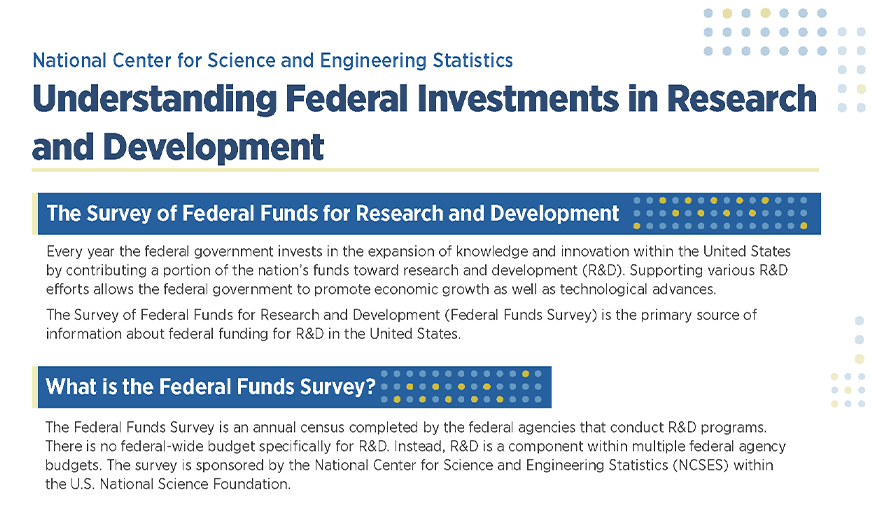
Purpose. The annual Survey of Federal Funds for Research and Development (Federal Funds for R&D) is the primary source of information about federal funding for R&D in the United States. The results of the survey are also used in the federal government’s calculation of U.S. gross domestic product at the national and state levels, for policy analysis, and for budget purposes for the Federal Laboratory Consortium for Technology Transfer, the Small Business Innovation Research, and the Small Business Technology Transfer. In addition, as of volume 71, the Survey of Federal Science and Engineering Support to Universities, Colleges, and Nonprofit Institutions (Federal S&E Support Survey) was integrated into this survey as a module, making Federal Funds for R&D the comprehensive data source on federal science and engineering (S&E) funding to individual academic and nonprofit institutions.
Data collection authority. The information is solicited under the authority of the National Science Foundation Act of 1950, as amended, and the America COMPETES Reauthorization Act of 2010. The National Center for Science and Engineering Statistics (NCSES) has reviewed this product for unauthorized disclosure of confidential information and approved its release (NCSES-DRN26-001).
Survey contractor. Synectics for Management Decisions, Inc. (Synectics).
Survey sponsor. NCSES within the U.S. National Science Foundation (NSF).
Target population. The population consists of the federal agencies that conduct R&D programs, excluding the CIA and the NSA. For the FYs 2024–25 cycle, one agency known to conduct R&D programs, the Library of Congress, was unable to report and did not provide inputs to estimate data. Therefore, data users should use caution when comparing survey results. A total of 30 federal agencies (14 federal departments and 16 independent agencies) were subject to R&D data collection during this cycle.
Sampling frame. The survey is a census of all federal agencies that conduct R&D programs, excluding the CIA and the NSA. The agencies are identified from information in the president’s budget submitted to Congress. The Analytical Perspectives volume and the “Detailed Budget Estimates by Agency” section of the appendix to the president’s budget identify agencies that receive funding for R&D.
Sample design. Not applicable.
Data collection. Data for FYs 2024–25 (volume 74) were collected by Synectics for Management Decisions, Inc. under contract to NCSES (for a full list of fiscal years canvassed by survey volume reference, see table A-4). Data collection began with an e-mail to each agency to verify the name, phone number, and e-mail address of each agency-level survey respondent. A Web-based data collection system is used for the survey. Because multiple subdivisions of some federal departments completed the survey, there were 67 agency-level respondents: 6 federal departments that reported for themselves, 46 agencies within another 8 federal departments, and 15 independent agencies. However, suboffices could also be authorized to enter data: in Federal Funds for R&D nomenclature, agency-level offices could authorize program offices, program offices could authorize field offices, and field offices could authorize branch offices. When these suboffices are included, there were 571 total respondents: 67 agencies, 110 program offices, 188 field offices, and 206 branch offices.
Since volume 66, each survey cycle collects information for 2 federal government fiscal years: the fiscal year just completed (FY 2024—i.e., 1 October 2023 through 30 September 2024) and the current fiscal year during the start of the survey collection period (i.e., FY 2025). FY 2024 data are completed transactions. FY 2025 data are estimates of congressional appropriation actions and apportionment and reprogramming decisions.
Data collection began on 28 May 2025, and the requested due date for data submissions was 6 August 2025. Data collection was extended until all surveyed agencies provided complete and final survey data in November 2025.
Mode. Federal Funds for R&D uses a Web-based data collection system. The Web-based system consists of a data collection component that allows survey respondents to enter their data online and a monitoring component that allows the data collection contractor to monitor support requests, data entry, and data issues. The Web-based system’s two components are password protected so that only authorized respondents and staff can access them. However, some agencies submit their data in alternative formats such as Excel files, which are later imported into the Web-based system. All edit and trend checks are accomplished through the Web-based system. Final submission occurs through the Web-based system after all edit failures and trend checks have been resolved.
Response rate. The unit response rate is 99.8% (the Library of Congress did not report).
Data checking. Data errors in Federal Funds for R&D are flagged automatically by the Web-based data collection system: respondents cannot submit their final data to NCSES until all required fields have been completed without errors. Once data are submitted, specially written SAS programs are run to check each agency’s submission to identify possible discrepancies, to ensure data from all suboffices are included correctly, and to check that there were no inadvertent shifts in reporting from one year to the next. As always, respondents are contacted to resolve potential reporting errors that cannot be reconciled by the narratives. Explanations of questionable data are noted by the survey respondents for NCSES review.
Imputation. None.
Weighting. None.
Variance estimation. Not applicable.
Sampling error. Not applicable.
Coverage error. Given the existence of a complete list of all eligible agencies, there is no known coverage error. The CIA and the NSA are purposely excluded. For the volume 74 (FYs 2024–25) survey cycle, one agency known for conducting R&D programs, the Library of Congress, was unable to report and did not provide inputs to estimate data. Therefore, data users should use caution when comparing survey results.
Nonresponse error. To increase item response, agencies are encouraged to estimate when actual data are unavailable. The survey instrument allows respondents to enter data or skip data fields; however, blank fields are not accepted for survey submission, and respondents must either populate the fields with data or with $0 if the question is not applicable. There are several possible sources of nonresponse error by respondents, including inadvertently skipping data fields, skipping data fields when data are unavailable, or entering $0 when specific data are unavailable.
Measurement error. Some measurement problems are known to exist in the Federal Funds of R&D data. Some agencies cannot report the full costs of R&D, the final performer of R&D, or R&D plant data.
For example, the Department of Defense (DOD) does not include headquarters’ costs of planning and administering R&D programs, which are estimated at a fraction of 1% of its total cost. DOD has stated that identification of amounts at this level is impracticable.
The National Institutes of Health (NIH) in the Department of Health and Human Services (HHS) currently has many of its awards in its financial system without any field of R&D code. Therefore, NIH uses an alternate source to estimate its research dollars by field of R&D. NIH uses scientific class codes (based upon history of grant, content of the title, and the name of the awarding institute or center) as an approximation for field of R&D.
The National Aeronautics and Space Administration (NASA) does not include any field of R&D codes in its financial database. Consequently, NASA has developed a method of estimating what percentage of the agency’s research dollars are allocated into the fields of R&D.
Agencies are asked to report the ultimate performer of R&D. However, through past workshops, NCSES has learned that some agencies do not always track their R&D dollars to the ultimate performer of R&D. In the case of transfers to other federal agencies, the originating agency often does not have information on the final disposition of funding made by the receiving agency. Therefore, intragovernmental transfers, which are classified as federal intramural funding, may have some degree of extramural performance. This leads to some degree of misclassification of performers of R&D, but NCSES has not determined the extent of the errors in performer misclassification by the reporting agencies.
Differences in agency and NCSES classification of some performers will also lead to some degree of measurement error. For example, although many university research foundations are legally organized as nonprofit organizations and may be classified as such within a reporting agency’s own system of record, NCSES classifies these as component units of higher education. These classification differences may have contributed to differences in findings by Federal Funds for R&D and the Federal S&E Support Survey in federal agency obligations to both higher education and nonprofit institutions. Now that the Federal S&E Support Survey has been incorporated into Federal Funds for R&D, it is easier to identify and resolve large differences.
R&D plant data are underreported to some extent because of the difficulty some agencies, particularly DOD and NASA, encounter in identifying and reporting these data. DOD’s respondents report obligations for R&D plant that are funded under the agency’s appropriation for construction, but they can identify only a small portion of the R&D plant support that is within R&D contracts funded from DOD’s appropriation for research, development, testing, and evaluation (RDT&E). Similarly, NASA respondents cannot separately identify the portions of industrial R&D contracts that apply to R&D plant because these data are subsumed in the R&D data covering industrial performance. NASA R&D plant data for other performing sectors are reported separately.
Data revisions. When completing the current year’s survey, agencies naturally revise their estimates for the last year of the previous report—in this case, FY 2024. Sometimes, survey submissions also reflect reappraisals and revisions in classification of various aspects of agencies’ R&D programs; in those instances, NCSES requests that agencies provide revised prior year data to maintain consistency and comparability with the most recent R&D concepts.
For trend comparisons, use the historical data from only the most recent publication, which incorporates changes agencies have made in prior year data to reflect program reclassifications or other corrections. Do not use data published earlier.
Changes in survey coverage and population. For the FYs 2024–25 cycle, one agency known to conduct R&D programs, the Library of Congress, was unable to report and did not provide inputs to estimate data.
Changes in questionnaire.
- No changes were made to the standard and DOD questionnaires for volume 74, FYs 2024–25.
- One question was added to the volume 73 standard questionnaire to collect details on FY 2023 and FY 2024 obligations from Public Laws 117-58, 117-167, and 117-169. This information was collected from the DOD through three suboffices that were added under the Fourth Estate’s Office of the Secretary of Defense and presented in these tables under Other defense agencies. These data are available upon request.
- For volume 73, the DOD questionnaire, NCSES started collecting Budget Activity 8, Software and Digital Technology Pilot Programs obligations to ensure complete coverage of DOD RDT&E data. Obligations for Budget Activities 7 and 8 were collected as a combined amount. This change appeared on DOD questions 1, 3, 5, 9, 10, 14, 18, 19, 20, and 21.
- For volume 73, both questionnaire versions, separate rows for American Samoa, Guam, Northern Mariana Islands, and U.S. Virgin Islands were added to the “state” questions (standard questions 12 and 13, DOD questions 13, 14, and 15). Those territories were no longer included under Other U.S. territories as had been the case in previous years. The Other U.S. territories definition was changed to include only Baker Island, Howland Island, Jarvis Island, Johnston Atoll, Kingman Reef, Midway Islands, Navassa Island, Palmyra Atoll, and Wake Island.
- The survey was redesigned for volume 71 (FYs 2021–22). The Federal S&E Support Survey was integrated as questions 18 and 19 on the standard questionnaire and questions 20 and 21 on the DOD questionnaire. (NCSES will continue to publish these data separately at https://ncses.nsf.gov/surveys/federal-support-survey/.)
- For volume 71, four other new questions were added to the standard and DOD versions of the questionnaire; for the fiscal year just completed (FY 2021), the questions covered R&D deobligations (standard and DOD question 4), R&D obligations to nonfederal performers by type of agreement (grants and contracts) (standard question 10 and DOD question 11), R&D obligations provided to other federal agencies (standard question 11 and DOD question 12), and R&D and R&D plant obligations to University Affiliated Research Centers (standard question 17 and DOD question 19). The one new question added solely to the DOD questionnaire (DOD question 6) was about obligations for Small Business Innovation Research and Small Business Technology Transfer for the fiscal year just completed and the current fiscal year at the time of collection (i.e., FYs 2021 and 2022). Many of the other survey questions were reorganized and revised.
- For volume 71, some changes were made within the questions for consistency with other NCSES surveys. Among the performer categories, federally funded R&D centers (FFRDCs), which in previous volumes were included among the extramural performers, became one of the intramural performers. Other changes include the retitling of certain performer categories, where “industry” was changed to “businesses” and “universities and colleges” was changed to “higher education.”
- For volume 71, “field of R&D” was used instead of the former “field of science and engineering.” The survey started collecting field of R&D information for experimental development obligations; previously, field of R&D information was collected only for research obligations.
- For volume 71, federal obligations for research performed at higher education institutions, by detailed field of R&D, was asked of all agencies. Previously these data had been collected only from the Department of Agriculture (USDA), DOD, the Department of Energy (DOE), HHS, the Department of Homeland Security (DHS), NASA, and NSF.
- For volume 71, geographic distribution of R&D obligations was asked of all agencies. Previously, these data had only been collected from USDA, the Department of Commerce (DOC), DOD, DOE, HHS, DHS, NASA, and NSF. Agencies are asked to provide the principal location (state or outlying area) of the work performed by the primary contractor, grantee, or intramural organization; assign the obligations to the location of the headquarters of the U.S. primary contractor, grantee, or intramural organization; or, for DOD agencies, list the funds as undistributed for classified funds.
- For volume 71, collection of data on funding type (stimulus and non-stimulus) was limited to question 5 on type of R&D. The Biomedical Advanced Research and Development Authority (BARDA) accounted for 93% of all COVID-19 pandemic-related R&D in FY 2021 and 94% in the FY 2022 preliminary estimate.
- For volume 70 (FYs 2020–21), agencies were requested to report COVID-19 pandemic-related R&D from the agency’s initial appropriations, as well as from any stimulus funds received from the Coronavirus Aid, Relief, and Economic Security (CARES) Act, plus any other pandemic-related supplemental appropriations. Two tables in the questionnaire were modified to collect the stimulus and non-stimulus amounts separately (tables 1 and 2), and seven tables in the questionnaire (tables 6.1, 6.2, 7.1, 11.1, 11.2, 12.1, and 13.1) were added for respondents to specify stimulus and non-stimulus funding by various categories. The data on stimulus funding is reported in volume 70’s data table 132. BARDA accounted for 66% of all COVID-19 pandemic-related R&D in FY 2020; these obligations primarily include transfers to the other agencies to help facilitate execution of contractual awards under Operation Warp Speed.
- For volume 70 (FYs 2020–21), the optional narrative tables that ask for comparisons of the R&D obligations reported in Federal Funds for R&D with corresponding amounts in the Federal S&E Support Survey (standard questionnaire only) were renumbered from tables 6B and 6C to tables 6A and 6B.
- In volumes 68 (FYs 2018–19) and 69 (FYs 2019–20), table 6A, which collected information on federal intramural R&D obligations, was deactivated, and agencies were instructed not to complete it.
- For volumes 66 (FYs 2016–17) and 67 (FYs 2017–18), table 6A (formerly table VI.A) was included, but it was modified so that it no longer collected laboratory names.
- Starting with volume 66 (FYs 2016–17), the survey collects 2 federal government fiscal years—actual data for the fiscal year just completed and estimates for the current fiscal year. Previously, the survey also collected projected obligations for the next fiscal year based on the president’s budget request to Congress. For volume 66, data were collected for only 2 fiscal years due to the delayed FY 2018 budget formulation process. However, after consultation with data users, NCSES determined that the projections were not as useful as the budget authority data presented in the budget request.
- In volume 66, the survey table numbering was changed from Roman numerals I–XI and, for selected agencies, the letters A–E, were changed to Arabic numerals 1–16. The order of tables remained the same.
- In the volume 66 DOD-version of the questionnaire, the definition of major systems development was changed to represent DOD Budget Activities 4 through 6 instead of Budget Activities 4 through 7, and questions relating to funding for Budget Activity 7, Operational Systems Development, were added to the instrument. The survey’s narrative tables 6 and 11 were removed from the DOD-version of the questionnaire.
- For volume 65 (FYs 2015–17), the survey reintroduced table VI.A to collect information on federal intramural R&D obligations, including the names and addresses of all federal laboratories that received federal intramural R&D obligations. The table was included in both the standard and DOD questionnaires.
- For volume 62 (FYs 2012–14), the survey added table VI.A to the standard questionnaire for that volume only to collect information on FY 2012 federal intramural R&D obligations, including the names and addresses of all federal laboratories that received federal intramural R&D obligations.
- In volumes 59 (FYs 2009–11) and 60 (FYs 2010–12), questions relating to funding from the American Recovery and Reinvestment Act of 2009 (ARRA) were added to the data collection instruments. The survey collected separate outlays and obligations for ARRA and non-ARRA sources of funding, by performer and geography for FYs 2009 and 2010.
- Starting with volume 59 (FYs 2009–11), federal funding data were requested in actual dollars (instead of rounded in thousands, as was done through volume 58).
Changes in reporting procedures or classification.
- FY 2024. For the FY 2025 estimates on volume 74 (FYs 2024–25), the Department of State, the Agency for International Development, and the Agency for Global Media reported minimum amounts of spending on R&D programs due to the suspension of operations.
- FY 2024. During FY 2024, federal agencies managed a large number of staff turnover resulting in many new respondents during the volume 74 cycle (FYs 2024–25). Some minor effects on comparability to previous years may have occurred due to changes in interpretation of survey instructions by agency respondents.
- FY 2023. During the volume 73 cycle (FYs 2023–24), several agencies corrected prior year data. The Agency for International Development and the Department of Transportation (DOT) corrected undercounts in their FY 2021 and FY 2022 data, DHS’s Science and Technology Directorate corrected its FY 2022 data in respect to University Affiliated Research Centers, and NASA corrected its FY 2021 data.
- FY 2023. The DHS classification of R&D obligations to some FFRDCs may not map directly to the FFRDC performance sector presented in the Federal Funds for R&D data tables. DHS is in the process of revising the classification of FFRDC obligations, and data will be adjusted and presented as revisions in the volume 74 (FYs 2024–25) data collection cycle.
- FY 2023. Two agencies reassessed their R&D activities in ways that resulted in sizeable reductions in their R&D obligations. The first agency, the Department of the Interior (DOI), reinterpreted the definitions of activities that constitute R&D. For the DOI’s National Park Service, this resulted in a reduction of about 80% in its R&D obligations. Its Bureau of Ocean Energy Management (BOEM) determined that its science programs and activities do not adequately meet all criteria to be considered research but are instead “applied science”; therefore, BOEM had $0 R&D spending to report. The second agency, the Centers for Medicare and Medicaid Services (CMS), had been developing and evolving a new budget system and determined that many activities labeled “Research and Demos” would no longer qualify as R&D. CMS pointed out that as an agency it is not as research focused as other HHS agencies; rather, it is focused on Medicare and Medicaid oversight and improving payment systems and methods to and from providers, states, and hospitals.
- FY 2023. The Department of State revised its reporting procedures to improve the accuracy of the agency’s obligations data for R&D associated with the Global Health Program. No revisions were applied to prior years’ obligations data from the Department of State.
- FY 2023. The HHS’s Advanced Research Projects Agency for Health (ARPA-H) began reporting for volume 73 (FYs 2023–24). Although ARPA-H is administratively managed by NIH, its R&D obligations are reported separately from NIH as a distinct component of HHS.
- FY 2023. The DOT’s Advanced Research Project Agency for Infrastructure is included in the report by the Office of the Secretary of Transportation, Office of the Assistant Secretary for Research and Technology.
- FY 2022. Two agency-level respondents ceased to report: the Department of the Treasury’s Internal Revenue Service (IRS) and the Federal Communications Commission.
- FY 2022. During the volume 72 cycle (FYs 2022–23), NASA revised its FY 2021 data by field of R&D and performer categories based on improved classification procedures developed during the volume 72 reporting period.
- FY 2022. The FY 2022 data could still include obligations from supplemental COVID-19 pandemic-related appropriations plus other pandemic-related supplemental appropriations.
- FY 2021. During the volume 71 cycle (FYs 2021–22), NCSES decided to remove “U.S.” from names like “U.S. Space Force” to conform with other surveys. For Federal Funds for R&D, this change first appeared in the detailed statistical tables.
- FY 2020. For volume 70 (FYs 2020–21), data included obligations from supplemental COVID-19 pandemic-related appropriations (e.g., CARES Act) plus any other pandemic-related supplemental appropriations.
- FY 2020. DOE’s Naval Reactor Program reclassified some of its R&D obligations from industry-administered FFRDCs to the industry sector.
- FY 2020. The Department of the Air Force (AF) and the DOE’s Energy Efficiency and Renewable Energy (EERE) partially revised their FY 2019 data. AF revised its operational system development classified program numbers for businesses excluding business or industry-administered FFRDCs, and EERE revised its outlay numbers.
- FY 2019. For volume 69 (FYs 2019–20), FY 2020 preliminary data did not include obligations from supplemental COVID-19 pandemic-related appropriations (e.g., CARES Act).
- FY 2019. BARDA began reporting. For volume 69 (FYs 2019–20), it could not submit any geographical data, so its data were reported as undistributed on the state tables.
- FY 2019. The Agency for Global Media (formerly the Broadcasting Board of Governors), which did not report data between FY 2008 and FY 2018, resumed reporting.
- FY 2018. HHS’s CMS funding was reported by the CMS Office of Financial Management at an agency-wide level instead of by the CMS Center for Medicare and Medicaid Innovation and its R&D group, the Office of Research, Development, and Information, which used to report at a component level.
- FY 2018. The Department of State added the Global Health Programs R&D funding.
- FY 2018. The Department of Veterans Affairs added funds for the Medical Services support to the existing R&D funding to fully report the total cost of intramural R&D. Although Medical Services do not directly fund specific R&D activities, they host intramural research programs that were not previously reported.
- FY 2018. DHS’s Countering Weapons of Mass Destruction (CWMD) Office was established on 7 December 2017. CWMD consolidated primarily the Domestic Nuclear Detection Office (DNDO) and a majority of the Office of Health Affairs, as well as other DHS elements. Prior to FY 2018, data reported for the CWMD would have been under the DNDO.
- FY 2018. DOE revised its FYs 2016 and 2017 data after discovering its Office of Fossil Energy reported “in thousands” instead of actual dollars for volumes 66 (FYs 2016–17) and 67 (FYs 2017–18).
- FY 2018. USDA’s Economic Research Service (ERS) partially revised its FYs 2009 and 2010 data during the volume 61 (FYs 2011–13) cycle. NCSES discovered a discrepancy that was corrected during the volume 68 cycle, completing the revision.
- FY 2018. DHS’s Transportation Security Administration, which did not report data between FY 2010 and FY 2017, resumed reporting for volume 68 (FYs 2018–19).
- FY 2018. DHS’s Secret Service, which did not report data between FY 2009 and FY 2017, resumed reporting for volume 68 (FYs 2018–19).
- FY 2018. NCSES discovered that in some past volumes, the obligations reported for basic research in certain foreign countries were greater than the corresponding obligations reported for R&D; the following data were corrected as a result: DOD and Chemical and Biological Defense FY 2003 data; defense agencies and activities FY 2003 and FY 2011 data; AF FY 2009 data; and Department of the Navy FY 2005, FY 2011, and FY 2013 data; DOE and Office of Science FY 2009 data; HHS and Centers for Disease Control and Prevention (CDC) FY 2008 and FY 2017 data; and NSF FY 2001 data. NCSES also discovered that some obligations reported for academic performers were greater than the corresponding obligations reported for total performers, and DOD and AF FY 2009 data, DOE and Fossil Energy FY 1999 data, and NASA FY 2008 data were corrected. Finally, NCSES discovered a problem with FY 2017 HHS’s CDC personnel costs data, which were then also corrected.
- FY 2017. The Department of the Treasury’s IRS performed a detailed evaluation and assessment of its programs and determined that none of its functions could be defined as R&D activity as defined in Office of Management and Budget (OMB) Circular A-11. The review included discussions with program owners and relevant contractors who perform work on behalf of the IRS. The IRS also provided a negative response to the OMB data call on R&D under Circular A-11 for the same reference period (FYs 2017–18). Despite no longer having any R&D obligations, the IRS still sponsors an FFRDC, the Center for Enterprise Modernization.
- FY 2017. NASA estimated that the revised OMB definition for "experimental development" reduced its reported R&D total by about $2.7 billion in FY 2017 and $2.9 billion in FY 2018 from what would have been reported under the previous definition prior to volume 66 (FYs 2016–17).
- FY 2017. The Patient-Centered Outcomes Research Trust Fund (PCORTF) was established by Congress through the Patient Protection and Affordable Care Act of 2010, signed by the president on 23 March 2010. PCORTF began reporting for volume 67 (FYs 2017–18), but it also submitted data for FYs 2011–16.
- FY 2017. The Tennessee Valley Authority, which did not report data between FY 1999 and FY 2016, resumed reporting for volume 67 (FYs 2017–18).
- FY 2017. The Postal Service, which did not report data between FY 1999 and FY 2016, resumed reporting for volume 67 (FYs 2017–18) and submitted data for FYs 2015–16.
- FY 2017. During the volume 67 (FYs 2017–18) data collection, DHS’s Science and Technology Directorate revised its FY 2016 data.
- FY 2016. The Administrative Office of the U.S. Courts began reporting as of volume 66 (FYs 2016–17).
- Beginning with FY 2016, the totals reported for development obligations and outlays represent a refinement to this category by more narrowly defining it to be “experimental development.” Most notably, totals for development no longer include the DOD Budget Activity 7 (Operational System Development) obligations and outlays. Those funds, previously included in DOD’s development totals, support the development efforts to upgrade systems that have been fielded or have received approval for full rate production and anticipate production funding in the current or subsequent fiscal year. Therefore, the data are not directly comparable with totals reported in previous years. For more information, refer to Statistical Definition of Development Clarified: Effect on Reported Federal R&D Totals (InfoBrief NSF 21-326), April 2021, available at https://ncses.nsf.gov/pubs/nsf21326.
- Prior to the launch of volume 66 (FYs 2016–17), the definitions of basic research, applied research, experimental development, R&D, and R&D plant were revised to match the definitions used by OMB in the July 2016 version of Circular A-11, Section 84 (Schedule C).
- FY 2015. HHS’s Administration for Community Living (ACL) began reporting in FY 2015, replacing the Administration on Aging, which was transferred to ACL when ACL was established on 18 April 2012. Several programs that serve older adults and people with disabilities were transferred from other agencies to ACL, including a number of programs from the Department of Education due to the 2014 Workforce Innovation and Opportunities Act.
- FY 2015. The DOI’s Bureau of Land Management and Fish and Wildlife Service, which did not report data between FY 1999 and FY 2014, resumed reporting.
- In January 2014, all Research and Innovative Technology Administration programs were transferred into the Office of the Assistant Secretary for Research and Technology in the Office of the Secretary of Transportation.
- FY 2014. DHS’s Domestic Nuclear Detection Office began reporting for FY 2014.
- FY 2014. The Department of State data for FY 2014 were excluded due to their poor quality.
- FY 2013. NASA revamped its reporting process so that the data for FY 2012 forward are not directly comparable with totals reported in previous years.
- FY 2012. NASA began reporting International Space Station (ISS) obligations as research rather than R&D plant.
- Starting with volume 62 (FYs 2012–14), an “undistributed” category was added to the geographic location tables for DOD obligations for which the location of performance is not reported. It includes DOD obligations for industry R&D that were included in individual state totals prior to FY 2012 and DOD obligations for other performers that were not reported prior to FY 2011. This change was applied retroactively to FY 2011 data.
- Starting with volume 61 (FYs 2011–13), DOD subagencies other than the Defense Advanced Research Projects Agency were reported as an aggregate total under Other defense agencies to enable complete reporting of DOD R&D (both unclassified and classified). Consequently, DOD began reporting additional classified R&D not previously reported by its subagencies.
- FY 2011. USDA’s ERS partially revised its data for FYs 2009 and 2010 during the volume 61 (FYs 2011–13) cycle.
- FY 2010. NASA resumed reporting ISS obligations as R&D plant.
- FYs 2000–09. Beginning in FY 2000, AF did not report Budget Activity 6.7 Operational Systems Development data because the agency misunderstood the reporting requirements. During the volume 57 data collection cycle, AF edited prior year data for FYs 2000–07 to include Budget Activity 6.7 Operational Systems Development data. These data revisions were derived from FY 2007 distribution percentages that were then applied backward to revise data for FYs 2000–06.
- FYs 2006–07. NASA’s R&D obligations decreased by $1 billion. Of this amount, $850 million was accounted for by obligations for operational projects that NASA excluded in FY 2007 but reported in FY 2006. The remainder was from an overall decrease in obligations between FYs 2006 and 2007.
- FY 2006. NASA reclassified funding for the following items as operational costs: Space Operations, the Hubble Space Telescope, the Stratospheric Observatory for Infrared Astronomy, and the James Webb Space Telescope. This funding was previously reported as R&D plant.
- FYs 2005–07. Before the volume 55 survey cycle, NSF updated the list of foreign performers in Federal Funds for R&D to match the list of countries and territories in the Department of State’s Bureau of Intelligence and Research fact sheet of Independent States in the World and fact sheet of Dependencies and Areas of Special Sovereignty. Area and country lists in volume 55 data tables and later may differ from those in previous reports.
- FYs 2004–06. NASA implemented a full-cost budget approach, which includes all of the direct and indirect costs for procurement, personnel, travel, and other infrastructure-related expenses related to a particular program and project. NASA’s data for FY 2004 and later years may not be directly comparable with its data for FY 2003 and earlier years.
- FY 2004. NIH revised its financial database; beginning with FY 2004, NIH records no longer contain information on the field of S&E. Data for FY 2004 and later years are not directly comparable with data for FY 2003 and earlier years.
- Data for FYs 2003–06 from the Substance Abuse and Mental Health Services Administration (SAMHSA) are estimates based on SAMHSA's obligations by program activity budget and previously reported funding for development.
- FY 2003. SAMHSA reclassified some of its funding categories as non-R&D that had been considered to be R&D in prior years.
- On 25 November 2002, the president signed the Homeland Security Act of 2002, establishing DHS. DHS includes the R&D activities previously reported by the Federal Emergency Management Agency, the Science and Technology Directorate, the Transportation Security Administration, the Coast Guard, and the Secret Service.
- FY 2000. NASA reclassified the ISS as a physical asset, reclassified ISS research as equipment, and transferred funding for the program from R&D to R&D plant.
- FY 2000. NIH reclassified as research the activities that it had previously classified as development. NIH data for FY 2000 forward reflect this change. For more information on the classification changes at NASA and NIH, refer to Classification Revisions Reduce Reported Federal Development Obligations (InfoBrief NSF 02-309), February 2002, available at https://www.nsf.gov/statistics/nsf02309.
- FYs 1996–98. The lines on the survey instrument for the special foreign currency program and for detailed field of S&E were eliminated beginning with the volume 46 survey cycle. Two tables depicting data on foreign performers by region, country, and agency that were removed before publication of volume 43 were reinstated with volume 46.
- FYs 1994–96. During the volume 44 survey cycle, the Director for Defense Research and Engineering (DDR&E) at DOD requested that NSF further clarify the true character of DOD’s R&D program, particularly as it compares with other federal agencies, by adding more detail to development obligations reported by DOD respondents. Specifically, DOD requested that NSF allow DOD agencies to report development obligations in two separate categories: advanced technology development and major systems development.
An excerpt from a letter written by Robert V. Tuohy, Chief, Program Analysis and Integration at DDR&E, to John E. Jankowski, Program Director, Research and Development Statistics Program, Division of Science Resources Statistics, NSF, explains the reasoning behind the DDR&E request:
“The DOD’s R&D program is divided into two major pieces, Science and Technology (S&T) and Major Systems Development. The other federal agencies’ entire R&D programs are equivalent in nature to DOD’s S&T program, with the exception of the DOE and possibly NASA. Comparing those other agency programs to DOD’s program, including the development of weapons systems such as F-22 Fighter and the New Attack Submarine, is misleading.”
- FYs 1990–92. Since volume 40, DOD has reported research obligations and development obligations separately. Tables reporting obligations for research, by state and performer, and obligations for development, by state and performer, were specifically created for DOD. Circumstances specific to DOD are (1) DOD funds the preponderance of federal development and (2) DOD development funded at institutions of higher education is typically performed at university-affiliated nonacademic laboratories, which are separate from universities’ academic departments, where university research is typically performed.
Agency and subdivision. An agency is an organization of the federal government whose principal executive officer reports to the president. The Library of Congress did not respond this cycle; however, it is typically included in this survey, even though the chief officer of the Library of Congress reports to Congress. Subdivision refers to any organizational unit of a reporting agency, such as a bureau, division, office, or service.
Development. See R&D and R&D plant.
Federal obligations for research performed at higher education institutions, by detailed field of R&D. As of volume 71, all respondents were required to report these obligations. Previously, this information was reported by seven agencies (USDA, DOD, DOE, HHS, DHS, NASA, and NSF).
Fields of R&D. A list of the 41 fields of R&D reported on can be found on the survey questionnaire. In the data tables, the fields are grouped into 9 major areas: computer and information sciences; geosciences, atmospheric sciences, and ocean sciences; life sciences; mathematics and statistics; physical sciences; psychology; social sciences; engineering; and other fields. Table A-3 provides a crosswalk of the fields of science and engineering used in volume 70 and earlier surveys to the revised fields of R&D collected under volume 71.
Geographic distribution of R&D obligations. As of volume 71, all respondents were required to respond to this portion of the survey. Previously, the 11 largest R&D funding agencies responded to this portion (USDA, DOC, DOD, DOE, HHS, DHS, DOI, DOT, the Environmental Protection Agency, NASA, and NSF). Respondents are asked to provide the principal location (state or outlying area) of the work performed by the primary contractor, grantee, or intramural organization, assign the obligations to the location of the headquarters of the U.S. primary contractor, grantee, or intramural organization, or list the funds as undistributed.
Obligations and outlays. Obligations represent the amounts for orders placed, contracts awarded, services received, and similar transactions during a given period, regardless of when funds were appropriated and when future payment of money is required. Outlays represent the amounts for checks issued and cash payments made during a given period, regardless of when funds were appropriated.
Performer. A group or organization carrying out an operational function or an extramural organization or a person receiving support or providing services under a contract or grant.
- Intramural performers are agencies of the federal government, including federal employees who work on R&D both onsite and offsite and, as of volume 71, FFRDCs.
- Federal. The work of agencies of the federal government is carried out directly by agency personnel. Obligations reported under this category are for activities performed or to be performed by the reporting agency itself or are for funds that the agency transfers to another federal agency for performance of R&D (intragovernmental transfers). Although the receiving agency may obligate these funds to extramural performers (businesses, universities and colleges, other nonprofit institutions, FFRDCs, nonfederal government, and foreign) they are reported as part of the federal sector by the originating agency.
Federal activities cover not only actual intramural R&D performance but also the costs associated with administration of intramural R&D programs and extramural R&D procurements by federal personnel. Intramural activities also include the costs of supplies and off-the-shelf equipment (equipment that has gone beyond the development or prototype stage) procured for use in intramural R&D. For example, an operational launch vehicle purchased from an extramural source by NASA and used for intramural performance of R&D is reported as a part of the cost of intramural R&D. These intramural R&D obligations should not be confused with R&D outlays, or performance of R&D, by federal agencies as is measured by the NCSES Federal Facilities Research and Development Survey.
- Federally funded research and development centers (FFRDCs)—R&D-performing organizations that are exclusively or substantially financed by the federal government and are supported by the federal government either to meet a particular R&D objective or in some instances to provide major facilities at universities for research and associated training purposes. Each center is administered by an industrial firm, a university, or another nonprofit institution (see https://ncses.nsf.gov/resource/master-gov-lists-ffrdc for the Master Government List of FFRDCs maintained by NSF).
- Extramural performers are organizations outside the federal sector that perform R&D with federal funds under contract, grant, or cooperative agreement. Only costs associated with actual R&D performance are reported. Types of extramural performers:
- Businesses—Organizations that may legally distribute net earnings to individuals or to other organizations.
- Higher education institutions—Domestic higher education institutions, military service academies, and consortia. Higher education institutions in the United States that engage primarily in providing resident or accredited instruction for a not less than a 2-year program above the secondary school level that is acceptable for full credit toward a bachelor’s degree or that provide not less than a 1-year program of training above the secondary school level that prepares students for gainful employment in a recognized occupation. Included are colleges of liberal arts; schools of arts and sciences; professional schools, as in engineering and medicine, including hospitals, clinics, and research institutes that are financial constituents of universities; and agricultural experiment stations. Other examples of universities and colleges include community colleges, 4-year colleges, universities, and freestanding professional schools (medical schools, law schools, etc.).
Consortia are organizations formed by the membership of multiple institutions from one or more types of performers (i.e., higher education or nonprofit) in order to promote and support efforts to enhance knowledge in one or more disciplines. Consortia that include both higher education institutions and nonprofits have been assigned to one of the two categories by NSF.
- Other nonprofit institutions—Domestic nonprofit organizations other than universities and colleges. Nonprofit organizations are businesses granted tax-exempt status by the IRS. Nonprofits pay no income tax on the donations they receive or on any money that they earn through fundraising activities. Nonprofit organizations are sometimes called nonprofit organizations or 501c organizations, based on the section of the tax code that permits them to operate. This category includes nonprofit hospitals that are not financial constituents of universities and consortia.
- State and local governments—State and local government agencies, excluding state or local universities and colleges, agricultural experiment stations, medical schools, and affiliated hospitals. (Federal R&D funds obligated directly to such state and local institutions are excluded in this category. However, they are included under the universities and colleges category in this report.) R&D activities under the state and local governments category are performed either by the state or local agencies themselves or by other organizations under grants or contracts from such agencies. Regardless of the ultimate performer, federal R&D funds directed to state and local governments are reported only under this sector.
- Non-U.S. performers—Other nations’ citizens, organizations, universities and colleges, governments, as well as international organizations located outside the United States, that perform R&D. In most cases, foreigners performing R&D in the United States are not reported here. Excluded from this category are U.S. agencies, U.S. organizations, or U.S. citizens performing R&D abroad for the federal government. Examples of foreign performers include the North Atlantic Treaty Organization, the United Nations Educational, Scientific, and Cultural Organization, and the World Health Organization. An exception in the past was made in the case of U.S. citizens performing R&D abroad under special foreign-currency funds; these activities were included under the foreign performers category but have not been collected since the mid-1990s.
- Private individuals—When an R&D grant or contract is awarded directly to a private individual, obligations incurred are placed under the category businesses.
R&D and R&D plant. Amounts for R&D and R&D plant include all direct, incidental, or related costs resulting from, or necessary to, performance of R&D and costs of R&D plant as defined below, regardless of whether R&D is performed by a federal agency (intramurally) or by private individuals and organizations under grant or contract (extramurally). R&D excludes routine product testing, quality control, mapping and surveys, collection of general-purpose statistics, experimental production, and the training of scientific personnel.
- Research is defined as systematic study directed toward fuller scientific knowledge or understanding of the subject studied. Research is classified as either basic or applied, according to the objectives of the sponsoring agency.
- Basic research is defined as experimental or theoretical work undertaken primarily to acquire new knowledge of the underlying foundations of phenomena and observable facts. Basic research may include activities with broad or general applications in mind, such as the study of how plant genomes change, but should exclude research directed toward a specific application or requirement, such as the optimization of the genome of a specific crop species.
- Applied research is defined as original investigation undertaken in order to acquire new knowledge. Applied research is, however, directed primarily toward a specific practical aim or objective.
- Development, also known as experimental development, is defined as creative and systematic work, drawing on knowledge gained from research and practical experience, which is directed at producing new products or processes or improving existing products or processes. Like research, experimental development will result in gaining additional knowledge.
For reporting experimental development activities, the following are included:
The production of materials, devices, and systems or methods, including the design, construction, and testing of experimental prototypes.
Technology demonstrations, in cases where a system or component is being demonstrated at scale for the first time, and it is realistic to expect additional refinements to the design (feedback R&D) following the demonstration. However, not all activities that are identified as “technology demonstrations” are R&D.
However, experimental development excludes the following:
User demonstrations where the cost and benefits of a system are being validated for a specific use case. This includes low-rate initial production activities.
Pre-production development, which is defined as non-experimental work on a product or system before it goes into full production, including activities such as tooling and development of production facilities.
To better differentiate between the part of the federal R&D budget that supports science and key enabling technologies (including technologies for military and nondefense applications) and the part that primarily supports testing and evaluation (mostly of defense-related systems), NSF collects development dollars from DOD in two categories: advanced technology development and major systems development.
DOD uses RDT&E Budget Activities 1–8 to classify data into the survey categories. Within DOD’s research categories, basic research is classified as Budget Activity 1, and applied research is classified as Budget Activity 2. Within DOD’s development categories, advanced technology development is classified as Budget Activity 3. Starting in volume 66, major systems development is classified as Budget Activities 4–6 instead of Budget Activities 4–7 and includes advanced component development and prototypes, system development and demonstration, and RDT&E management support. Budget Activities 1–6 count as R&D. Data on Budget Activity 7, Operational System Development, and as of volume 73, Budget Activity 8, Software and Digital Technology Pilot Programs, are collected separately and ensure full coverage of DOD RDT&E. (Note: As a historical artifact from previous DOD budget authority terminology, funds for Budget Activity categories 1 through 7 are sometimes referred to as 6.1 through 6.7 monies.)
- Demonstration includes amounts for activities that are part of R&D (i.e., that are intended to prove or to test whether a technology or method does in fact work). Demonstrations intended primarily to make information available about new technologies or methods are excluded.
- R&D plant is defined as spending on both R&D facilities and major equipment as defined in OMB Circular A-11 Section 84 (Schedule C) and includes physical assets—such as land, structures, equipment, and intellectual property (e.g., software or applications) that have an estimated useful life of 2 years or more—or commodity inventories.
Reporting for R&D plant includes the purchase, construction, manufacture, rehabilitation, or major improvement of physical assets regardless of whether the assets are owned or operated by the federal government, states, municipalities, or private individuals. The cost of the asset includes both its purchase price and all other costs incurred to bring it to a form and location for its intended use.
Obligations for foreign R&D plant are limited to federal funds for facilities that are located abroad and used in support of foreign R&D.
For reporting construction of R&D facilities and major moveable R&D equipment, include the following:
Funding for the construction of facilities that are necessary for the execution of an R&D program. This may include land, major fixed equipment, and supporting infrastructure such as a sewer line, or housing at a remote location. Many laboratory buildings will include a mixture of R&D facilities and office space. The fraction of the building directly related to the conduct of R&D may be calculated based on the percentage of the building’s total square footage.
Acquisition, design, or production of major movable equipment, such as mass spectrometers, research vessels, DNA sequencers, and other major movable instruments for use in R&D activities.
Programs of $1 million or more that are devoted to the purchase or construction of R&D major equipment.
Agency R&D plant costs for non-U.S. performers.
Exclude the following:
Construction of other facilities, such as office space.
Minor equipment purchases, such as personal computers, standard microscopes, and simple spectrometers (if part of an R&D activity, report these costs under R&D conduct, not R&D Plant).
 An official website of the United States government